Invest in Russia — invest in Russian regions!
All analytics

Business Guide. National Technology Initiative

Analytical digest
26 March 2019

The specialist supplement to the Kommersant broadsheet is an analytical digest describing primary technologies, long-term development goals, and main participants of each of the National Technology Initiative (NTI) markets. The supplement also contains several interviews with key government officials and representatives of development institutions.

The National Technology Initiative was launched in 2015 as a mechanism for providing direct support for projects on promising, though not yet explored, markets. From now on, the initiative will offer a wide range of development tools for the business community, including links with universities. This will help bridge the gap between business and science, which is the fundamental principle of the revised NTI logic.

Currently, the NTI markets include AutoNet, AeroNet, MariNet, NeuroNet, HealthNet, EnergyNet, TechNet, the Club (Kruzhok) movement, SafeNet, FinNet, and FoodNet. The digest describes and analyzes the structure of the funding provided for NTI projects as of November 1, 2018. The analysis demonstrates that the largest investments are currently channelled into NeuroNet and AeroNet. According to Alexander Povalko, General Director of the Russian Venture Company (RVC), from now on, top priority will be given to financing on a repayable basis via venture capital funds and loan-based funding. For this purpose, five funds have already been launched which will concentrate on financing NTI projects.

Andrey Belousov, Aide to the President of the Russian Federation, observes in an interview to Business Guide that during the last few years the country has managed to launch or relaunch several sectors with high technological activity, a considerable number of startups have been founded, while technological development has become the focus of public discourse. At the same time, infrastructure centers for NTI are being created on the basis of existing markets. These centers will be aimed at working with communities, monitoring legal constraints and devising new regulatory instruments, as well as providing expert opinion and analytical data. The NTI Platform, which is in the process of being launched, will also be working with the business community. The University 20.35 of the NTI, in its turn, should ensure professional development for individuals in the digital economy.

Technological contests in the NTI aimed at solving specific engineering tasks, unsolved yet anywhere in the world, are seen as a new tool for discovering breakthrough technologies. RVC is planning to hold six technological contests before the end of 2020 in such fields as genetic engineering, artificial intelligence in medicine and healthcare, assistive technologies, and technologies aimed at labor productivity gains.

Anlytics on the topic

All analytics
Research
26 March 2018
The Rise and Rise of Private Equity

McKinsey provides an annual review of the private property market showing scaling in 2017. The way owners respond to the opportunities that arise will be critical to their success.

Research
9 July 2020
Returning to work in the future of work. Embracing purpose, potential, perspective, and possibility during COVID-19

In this report, Deloitte discusses main challenges faced by social enterprises and offers suggestions on ways to build a sustainable post-crisis future of work.

Articles
6 September 2018
National and local branding as a regional development tool

The challenges faced by Russia become more complex every year, requiring changes in the conceptual approach to developing economic potential.

Research
26 March 2018
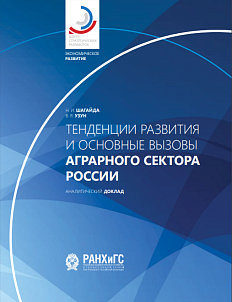
Development Trends and Key Challenges in Russian Agricultural Industry

The Centre for Strategic Research publishes the report Development Trends and Key Challenges in Russian Agricultural Industry prepared in partnership with the Centre for Agrifood Policy at Russian Academy of National Economy and Public Administration (RANEPA). The purpose of the report is to demonstrate that the agricultural sector is developing rapidly but this development can be affected by underestimated new challenges.