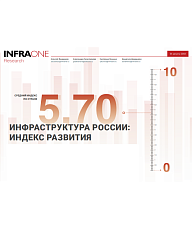
The InfraONE experts believe that infrastructure development in Russia has lacked consistency for the last few decades: there is no definite plan for systematic spatial development, nor uniform statistics, nor a uniform assessment system. When regional and federal authorities invest in transportation, energy, housing and utilities, schools, and hospitals, the planning horizon rarely exceeds two or three years; besides, the approved development strategies arent always followed.
The report shows that by the level of infrastructure development and the volumes of investments in infrastructure, the leading regions are Moscow, Saint Petersburg, and Khanty-Mansi Autonomous Okrug. Moscow is leading by a considerable margin, being far ahead of the average country index (by almost 36.5%). According to InfraONE, this gap can hardly be narrowed in the next 7 to 10 years. Still, none of the regions has attained the maximum development index of 10 neither composite, nor on an industry scale, which indicates a lack of funding in all spheres and in all the regions.
The leading regions have managed to take their positions mainly due to a developed transportation infrastructure which is traditionally the most capital-intensive; social infrastructure in these federal subjects is lagging behind because the load on it exceeds its capacity. Nominally, the level of infrastructure development is nearly the same in most federal subjects; in practice, however, this means that they are below the average country figures in two or more sectors of the five selected for analysis. The lowest results are shown by Chechnya, Tuva, and Dagestan, where infrastructure is poorly developed due to these regions low accessibility (mountainous territories) and low share of urban population.
Transportation infrastructure is developed the least: average country index for this sector is only 3.24 out of 10; the best developed sectors are housing and utilities (6.89) and telecommunications (6.48). The gap between transportation and other sectors will hardly be closed soon because transportation is much more expensive and much harder to develop. In telecommunications and in the housing and utilities sector, conversely, the number of private investors is greater while the cost of projects is lower. Besides, the dependence on the share of urban population is much higher here because the infrastructure is concentrated on a much smaller territory compared to, for example, highways or railroads.
.png)
As estimated by InfraONE, Russias minimum requirements for additional investment in infrastructure will equal 2.6 trillion rubles in 2019. The greatest share (52.6%) of these funds, however, will cover the needs of as few as 27 regions where infrastructure is already developed, which indicates a low level of economic development and a necessity for large-scale investment in both infrastructure and industry. According to calculations done by InfraONE experts, Russias minimum requirements for extra investment in infrastructure can be met as soon as in 2021, provided that investments following the May Decrees are made in accordance with the current plan of the Ministry of Finance. Still, there is a high risk that investments will again be channeled mostly in extra-large and megaprojects on a federal scale arranged via public contracts, while the current shortage of high-quality projects based on public private partnership will continue.
.png)