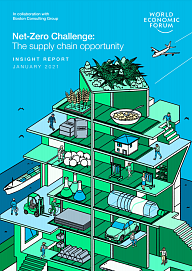
The research prepared by the experts of the World Economic Forum together with BCG examines the issues of climate change and the opportunities that all companies have to influence the climate issues through actions on decarbonizing global supply chains.
The Roscongress Foundation presents the salient points of the publication accompanied by fragments of broadcasts of relevant panel discussions from the business programme of international events held by the Roscongress Foundation.
Although supply chain decarbonization processes pose a number of challenges, companies can greatly enhance their positive impact on climate issues by implementing them.
For companies in the more customer-focused sectors, the through emissions are much higher than the direct emissions of the last segment. By engaging suppliers to create zero emissions in chains, companies can improve their climate footprint, ensure emissions reductions in sectors that are struggling in terms of this issue, and accelerate actions on climate change in countries where it would not otherwise be a priority.
But it is important to note that decarbonizing supply chains is difficult. Even leading companies have trouble getting the data they need and setting clear goals and standards for their suppliers to adhere to. Engaging the often fragmented supplier landscape is challenging, especially when emissions are «rooted» deep in the supply chain, or when fixing them may require collective action at the level of the industry.
It should also be noted that eight supply chains account for more than 50% of the world’s emissions. Food, construction, clothing, consumer goods, electronics, automotive, professional services, and trucking account for more than half of the world’s greenhouse gas emissions. A significant proportion is indirectly controlled by only a few companies.
Zero-waste supply chains will not increase costs for end users.
About 40% of all emissions in these supply chains can be reduced with readily available levers, such as cycling, efficiency, and renewable energy, with minimal impact on product costs. Even with zero emissions in the supply chain, end-user costs will increase by a maximum of 1–4% in the medium term.
To solve the problem of supply chain decarbonization, there are a number of steps that every company can take.
The research examines nine major initiatives that each company can take. Interviews with several dozen global companies that are leading the way in reducing supply chain emissions identified nine key actions:
1. to create a comprehensive baseline emissions plan, progressively updated with actual data on suppliers;
2. to set ambitious and comprehensive emission reduction goals;
3. to reduce emissions by revising product design options;
4. to reduce emissions by revising the (geographic) supply strategy;
5. to set ambitious procurement standards;
6. to work together with suppliers to co-finance emission reduction measures;
7. to work together with colleagues to agree on sectoral goals that maximize impact and level the playing field;
8. to use scale by increasing demand to reduce the cost of green solutions;
9. to develop internal management mechanisms under which emissions act as a control mechanism and link decision makers’ incentives to emission targets.
For more information, see the special sections of the Roscongress Foundation Information and Analytical System: Sustainable Development devoted to global challenges and responses to them; Climate Change, Environment and «Green» technologies, which provide information on environmental problems and ways to solve them.