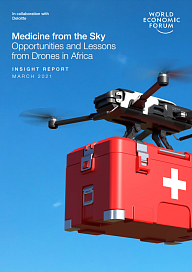
The research prepared by experts of the World Economic Forum in cooperation with Deloitte examines the problem of providing people with high-quality medical care in remote areas on the example of the use of drones for the delivery of medical supplies in Africa.
The Roscongress Foundation presents the salient points of the publication accompanied by fragments of broadcasts of relevant panel discussions from the business programme of international events held by the Roscongress Foundation.
The drone ecosystem in Africa is growing rapidly.
In the past six years, as drone programs have become more common in Africa, the ecosystem has gone from a few pioneering programs in Rwanda and Malawi to nearly a dozen programs across the continent, including in Malawi, the Democratic Republic of Congo, Ghana, Nigeria, Senegal, Ethiopia, Sierra Leone and South Africa. Ideally, they would become long-term sustainable programs, but it will become clear only after some time.
The technology for delivering medical supplies by drone has many advantages.
Technologies for delivering medical supplies by drones not only save lives, but also save costs and time. Unmanned aerial vehicles can encourage new investment and open the door to investment in infrastructure, a trained workforce, advanced aerial exploration applications and enhanced airspace mobility. Naturally, drones do not solve all the problems and cannot be used in every situation. Unmanned aerial vehicles for delivering medical supplies, for example, are just one of many possible ways to transport goods. However, drones can provide significant economic and time advantages in transporting vital materials between two sites in many remote areas.
The African continent is a world leader in the use of unmanned aerial vehicles for medical purposes and continues to advance in this direction.
The African continent is a world leader in the use of unmanned aerial vehicles for medical purposes. Over the years, it has served as a testing ground for innovative technologies and regulatory solutions. The continent should continue to move forward by exploring unmanned traffic control systems and identification methods such as remote identification. This will allow to both widely implement the technology of unmanned aerial vehicles and to support the continent’s position as a leader in the ecosystem.
A number of conditions are important for the successful implementation of drone use programs.
Having analyzed a range of data, the authors of the research concluded that the most important input factors for the successful adoption of technology are a suitable business model, existing transportation costs and the number of people served. Given the carefully designed business structure and existing transportation challenges, the analysis results strengthen the arguments for implementing large-scale, sustainable programs that will not only save lives, but also improve operational efficiency and ensure economies of scale.
Among other enabling factors, the authors of the research highlight the availability of space for unmanned aerial vehicles to be able to quickly get into the supply chain, a regulatory environment that is not hostile to drone technology, and a community that embraces the technology and sees the value it brings. It is also important to note that drones already play a certain role in the fight against COVID-19. This scalable and contactless technology has proven successful in early examples of use in Africa and is now intended for widespread use.
Video: https://roscongress.org/sessions/era-bespilotnikov-na-transporte-chto-dalshe-/search/#00:10:28.479
For more information, see the special sections of the Roscongress Foundation Information and Analytical System: Medicine and Healthcare devoted to the development of medicine and health care fields, also Driverless vehicles и Digitalization, which provide information on the processes of implementing new technologies.