Global banking trends
A number of long-term trends in the global financial sector indicate that the market share of digital financial technologies is highly likely to continue growing. Globally, 56% of financial institutions have already made digital transformation part of their business strategy. The high growth rate of financial technologies is evidenced by the fact that as far back as in 2016, the volume of investments in fintech companies reached USD 24.7 bn, twice more than in 2013. On a five-year horizon, 82% of financial institutions expect a growth in the number of partnerships with fintech companies.
These facts indicate that the scale and the pace of penetration of technologies into the financial market will keep growing. This will require greater flexibility on the part of the regulator. This is why state participation in the development of digital financial technologies has already become a crucial factor in the development of digital economy.
Main trends in the Russian banking sector
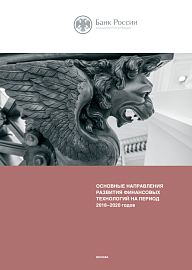
The Guidelines for Financial Technologies Development for 2018-2020 are closely linked with Russia’s national program for the development of digital economy. Also, the Guidelines reflect the results of an analysis of banking trends carried out by the Bank of Russia experts. These trends are important because they create the environment for the progress of financial technologies. They include low bank margin; transformation of business models, with the market participants striving to create eco-systems; greater penetration of financial services due to their digitalization; loss of banks’ monopoly for traditional banking services (payments and other services), with non-financial organizations acquiring a considerable role on the financial market; tendency for banks to partner with startups and tech companies.
Role of innovation and key financial technologies
Based on research done while preparing the Guidelines, experts have identified the following financial technologies as the most promising: Big Data and information analysis, mobile technologies, artificial intelligence, robotization, biometrics, distributed ledgers, cloud technologies.
Financial technologies modernize traditional financial and other services by supplying them with innovative products and services for end consumers. This is particularly evident in such segments as online payments, P2P online money transfers, P2P currency exchange, B2B payments and transfers, cloud cash registers and smart terminals, mass payouts, P2P consumer crediting, P2P business crediting, crowdfunding, robo-advising, programs and applications on financial planning, social trading, algorithmic exchange trading, special purpose savings.
Other key directions of financial technologies include analysis, research and proposals for the use of new financial technologies; transition to electronic interaction; creation of the Bank of Russia’s regulatory environment; formation of a common payment space within the EAEU; human resource development.
Prospects for fintech development
To ensure that the national digital financial environment develops and functions in a safe and efficient way, it is essential that all market participants take coordinated action. Also, timely and adequate regulation will play a crucial role in, first, ensuring the stability of the financial system and the protection of consumer rights, and second, fostering the progress of innovative digital technologies.
Importantly, the development of digital technologies entails cyber risks which must be monitored, detected, and assessed in a timely manner. Also, prevention or mitigation strategies must be developed.