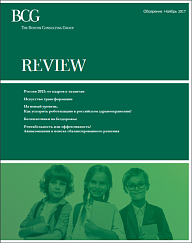
The issue is opened with an overview article on the materials of the survey Russia 2025: From Personnel to Talents, prepared jointly by BCG, WorldSkills Russia and Global Education Futures with the support of Sberbank. At the center of the survey is the need to move from a resource economy to a knowledge economy and thus to ensure Russias competitiveness in the modern world. If the existing labour market structure is maintained for another 7-10 years, Russias lagging behind the world economic leaders risks becoming irreducible, so it is necessary to act without delay.
According to the Tretyakov Gallery experience large-scale transformations and excellent results in a very short time are real. When Z.I. Tregulova was appointed a general director in 2015, the situation was difficult both with financing, and perception of the museum. However, already in 2016 with the Aivazovsky exhibition for the first time in the history of Russian museums, the Tretyakov Gallery was included in the list of Top 10 in the World, that is, among the 10 most important art exhibition projects in the world, and the number of visitors for two years has almost doubled. To get information about how this was achieved read the interview with Z.I. Tregulova called Transformation Art. The first successful experiments in the use of robots in medicine and healthcare have been known since the 1980s, as well as innovations in surgery, but the systemic reorganisation of the medical institution from the point of view of automation is still a rare phenomenon. The advantages of such automation are obvious, but managers often linger at the start because of the lack of a clear idea of how to introduce robots. The article Towards a New Level: How to Accelerate Robotisation in Russian Health Care?" offers a number of measures that will help to introduce robits both at the level of the medical centre and at the state level. Autonomous cars have become a new area of competition in the global transport industry. By 2025, the total output of cars with autopilot systems will be about 600,000, and by 2035 21.1 million. What are the prospects for innovative automotive technologies for Russian manufacturers? Now the profitability of the automotive industry is falling and, therefore, the risk of the industry development solely by the model of the «local collector» increases. Obviously, the «local innovator» strategy, including breakthrough developments in the field of autonomous transport, would be more promising. Read more about this in the article Unmanned Vehicles on the Roads. In the comments to the article Profitability or Efficiency? The airline is looking for a balanced solution. Nicolas Boutin, BCG partner and head of the global aerospace industry expert practice, notes that Russian airlines are achieving good results in improving efficiency, but the balance between profitability and efficiency remains relevant for a number of reasons: aggravation of competition, increase in the number of connecting flights, growing demands and expectations of customers. In todays hypercompetitive aviation industry, those companies that will manage to increase efficiency, without worsening but improving the quality of customer service, will be able to increase profits by 5-10%. This is not easy, but the results will be seen and appreciated by customers, employees, and investors.
.png)