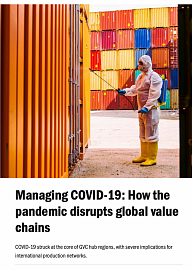
In this article, UNIDO’s Department of Policy Research and Statistics studies the negative effects of the coronavirus pandemic on global value chains.
The Roscongress Foundation presents the salient points of the publication accompanied by fragments of broadcasts of relevant panel discussions from the business programme of international events held by the Roscongress Foundation.
COVID-19 containment measures resulted in an unprecedented drop in industrial production in China.
For many goods, China is at the heart of global value chains (GVCs) as a primary producer of high-value products and components, as a large customer of global commodities and industrial products, and as a major consumer marketplace. China is also producing many intermediate inputs and is responsible for processing and assembly operations. Its assembly plants produce for many world-leading electronics companies, among them Apple, Intel, and Sony. China, along with Japan, the United States, and the European Union, forms the very core of the global production network.
The effect of COVID-19 containment measures is visible in data on industrial production in China, which has fallen by 13.5% in January and February combined, compared with the previous year. This drop in production is severe: neither the SARS outbreak in 2002/2003 nor the financial crisis in 2008/2009 was associated with any such stark drop in production.
The collapse in industrial activity in China implies that many production parts that are vital for uninterrupted functioning of global value chains are missing.
The unprecedented drop in industrial production in China is associated with a significant reduction of global trade flows. According to China’s General Administration of Customs, in January/February 2020 China’s imports and exports shrank by 4% and 17% respectively, compared to the same period of the previous year.
Currently, industrial production is heavily reliant on imported components. According to a German statistical office, in the German manufacturing sector imported inputs represent roughly a quarter of industrial production, with 10% of all imported inputs coming from China. This reliance on Chinese intermediates for production in Germany is particularly strong in the electronics, computing and textile manufacturing sectors.
The ‘second shock’ of the drop in demand resulting from lockdowns has a negative effect on investments.
The example of China, the first country to go through a full cycle of the epidemic, demonstrates that manufacturers now have to deal with the double negative consequences (‘second shock’) of first their own lockdown and second the drop in demand from customers further up the numerous value chains. If other global GVC hubs experience similar trajectories the cumulative effect of supply bottlenecks and falling consumer demand may indeed increase the risk of global manufacturing entering a downward spiral, possibly causing significant damages to operations of many cross-border supply chains.
This ‘second shock’ is not confined to production and trade only, but is quickly spilling over to investments as well. Most recently, the International Monetary Fund (IMF) has reported a staggering USD 83 billion of capital outflows from emerging markets, which were the largest outflows ever recorded.
A nationalization or regionalization of supply chains, as a path out of the crisis, has the risk to further reduce diversification of suppliers in the world economy and reduces opportunities for developing and emerging economies.
The discussion around current and future policy responses has seen increasing calls for national re-examination of established economic models, in particular with respect to international outsourcing of production, with a view to avoiding future supply bottlenecks while increasing resilience of supply chains and reducing their reliance on imported inputs. If the global economy is to avoid prolonged economic distress, a coordinated policy response, as advocated by the United Nations and other multilateral policy institutions, serves as possibly the most promising path out of a looming economic crisis.
A substantive nationalization or regionalization of supply chains has the risk to further reduce diversification of suppliers in the world economy and reduces opportunities for developing and emerging economies. Meanwhile, COVID-19 demonstrates that the current approach to production outsourcing based on minimizing costs, reducing inventories and driving up asset utilization is no longer effective in the present conditions.
For more information about possible ways to stabilize the economy during the pandemic, please see the StayHomeEconomy special section of the Roscongress information and analytical system, and the Investment climate and Supply chain management sections about economic development in a market economy.