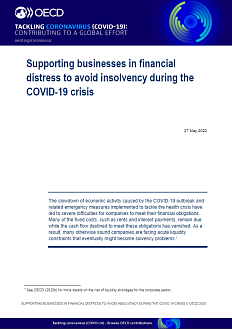
The Organisation for Economic Cooperation and Development has prepared analytical research on business support mechanisms to avoid insolvency during the COVID-19 crisis. The slowdown of economic activity caused by the COVID-19 outbreak and related emergency measures implemented to tackle the health crisis have led to severe difficulties for companies to meet their financial obligations. Many of the fixed costs, such as rents and interest payments, remain due while the cash flow destined to meet these obligations has vanished. As a result, many otherwise sound companies are facing acute liquidity constraints that eventually might become solvency problems.

There is a number of scenarios for societal and business impact of the coronavirus situation. Deloitte experts offer three scenarios of what awaits us in the next 1.52 years under new conditions. Those scenarios can be used for short- and medium-term strategic, operational, and financial planning.

The Global Trends 2040: A More Contested World report was produced by the United States National Intelligence Council for the incoming US president. The report assesses global trends over a time horizon of fifteen years.

The RIAC study presents an analysis of the impact of the crisis caused by the COVID-19 pandemic on vast regions of the world that are conventionally referred to as the «global South»: countries in Asia, Africa and Latin America.