The green bond market is rapidly growing
The green bond market emerged in 2007-2008, with the first instances of issues by international development banks, and now represents a rapidly growing and long-term perspective segment of the global financial market. At the same time, large institutional investors are showing increased interest in the market. The green bond issuance of developing countries reached $14.6 billion, or 19 percent of the overall volume of issues in the first half of 2018. According to expert predictions, taking the supranational organizations of developing countries into account (such as the Asian Development Bank or the African Development Bank), the share of green bonds of developing countries will increase to $21.5 billion and will reach 28 percent in the near future.
On September 1, 2018, about 50 of Russian companies had issued corporate or concessionary bonds, with a total of 420 issues in circulation worth 6.5 trillion rubles. Another 37 issues worth 1.3 trillion rubles are planned for listing (issues are included in the list of securities accepted for trading by Moscow Exchange PJSC). Some issues in this list have good chances of being labeled «green». However, when creating a national system of green bond verification, it is necessary to make provisions for integrating the national system and the existing international systems. Also, the distinctive features of Russias economic structure should be kept in mind.
Russia is interested in further development of green finance market
Investment opportunities in green development will create demand from national enterprises, and will contribute to the growth of green technology transfer from abroad and the increase of technology available to companies. At this point, Russia has already laid the legal foundation for the transition to a green economy by adopting a number of regulatory legal acts aimed at implementing measures to adapt to climate change and mitigate its impact.
At present, distinct instruments for the development of the green finance market have been set up in Russia, including methodologies and standardization, environmental risk assessment, environmental audit, indices and ratings. Registers of non-financial reports on sustainable development have been developed and are administered by expert institutions.
However, for a full-scale formation and development of the green finance market in Russia, there remains much work to be done
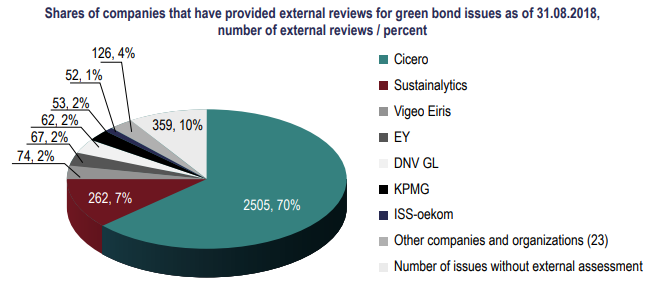
Despite the creation of a regulatory framework for the assessment of green projects, a system of verification and certification of green bonds and other financial instruments has not been established. In Russia there are no unified principles of green finance, nor are there any methods to verify and certification them. In this regard, the first step would be identification on behalf of the market players, the disclosure of relevant information with existing institutions of environmental review to develop the verification and certification of green financial instruments.
The Diagnostic Overview also contains a road map for the formation of a green finance market in Russia which includes the following sets of measures: the development of the ideology and consolidated position of regulators in relation to the green finance market at the national level; creating a national Methodological Center in the field of green finance; creating and adopting principles, standards and taxonomy; the formation of the system of verification for green financial instruments, etc.