Overall situation in global e-commerce
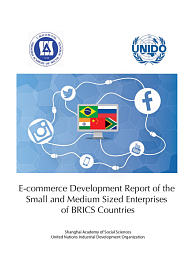
In this report, prepared by a research group from the Shanghai Academy of Social Sciences (SASS) and the United Nations Industrial Development Organization (UNIDO), the authors observe that the rapid growth of e-commerce in global retail trade is attracting increasing attention. The analysts expect that the proportion of e-commerce in the global retail trade will increase from 7.4% in 2014 to 14.6% in 2020. Additionally, with the use of ICT, Artificial Intelligence and other modern information technologies, e-commerce will have profound impacts on global production networks and retail businesses. The development of mobile e-commerce and social media is changing lifestyle patterns and consumption. Emerging countries, especially BRICS nations, which account for 42.19% of the world population, represent a large pool of potential consumers and Internet users. With increasing penetration rate of BRICS nations’ mobile Internet, the development of e-commerce in these emerging economies has a bright future. For example, according to calculations done by the International Trade Center (ITC), in 2017, the percentage of Internet users who transact online was 17.5% in Russia and 19.2% in China (to compare, among global Internet users, the average percentage of online shoppers is 16%).
BRICS e-commerce markets
Although there are wide national differences in the development of BRICS e-commerce, the momentum of overall growth is strong. The average rate of growth of BRICS e-commerce is around 20% (China has recorded an annual growth rate of above 37%), which is far above the global average. In terms of growth rates of e-commerce trade, China, India and South Africa are the fastest-growing markets. The growth rates of Brazil and Russia have fluctuated due to various factors. China and India have the largest e-commerce trade volumes while Russia, Brazil and South Africa have smaller trading volumes because of their relatively smaller economies. BRICS e-commerce has provided a platform for the development of SMEs, which has driven the generation of employment opportunities.
Main problems faced by e-commerce
The most common challenges faced in BRICS e-commerce development include lack of adequate data, logistics infrastructure, trust, regulations, cross-border customs clearance, and talent. However, over and above these shared issues, each BRICS country has its own unique problems and challenges. For example, e-commerce development in Brazil is faced with customs and tax problems. In Russia, the language barrier in cross-border e-commerce stands out. In South Africa, payment and logistics are a problem. In China, loss of trust in e-commerce is coupled with a need for improvements in regulation, especially in the area of consumer protection.
Rules and standards of e-commerce trade in BRICS countries
Though individual BRICS countries have established varying laws and regulations pertaining to e-commerce transactions and security systems, there is a need to set up unified regulatory standards for cross-border trade among BRICS countries. In China, although there are laws relating to e-commerce, because the unified «e-commerce law» has not been formulated, the present legal norms are fragmented, vague, and unable to cope with the rapid development and continuous innovation in e-commerce. In comparison, Russian e-commerce legislation was introduced relatively earlier and the e-commerce laws have been updated regularly. Indian electronic business related policies and legislations are unclear, which is likely to cause uncertainty for enterprises. The Brazilian system of e-commerce related legislation is slow and depends almost completely on two laws. In South Africa, existing legislation is not comprehensive and has not kept up with e-commerce development.
From the perspective of transaction security and consumer protection, China has clearly defined responsibilities and obligations of e-commerce third-party platforms, and placed the establishment of consumer protection and service guarantee mechanism on the agenda. In Russia, cybersecurity and credit problems have become increasingly prominent. India has promulgated and implemented consumer protection laws in certain areas. Brazilian Internet and online payments do not receive effective protection. The South African legal framework still has scope to improve the prevention of unfair competition and encryption of information.
Proposals to strengthen e-commerce cooperation between BRICS countries
BRICS e-commerce cooperation will enable the rapid development of e-commerce. The establishment of a common interest is the core and foundation of BRICS e-commerce cooperation.
Within the framework of BRICS economic partnership and strategic cooperation, in order to commit to e-commerce, member countries need to establish an e-commerce cooperation mechanism. They also need to focus on strengthening capacity, including technological innovation, skills and professional training, infrastructure, such as ICT, logistics and distribution, transportation capacity, technical support for e-commerce development, information exchange for e-commerce logistics between member countries, and cooperation and innovation in mobile payment technology, with a focus on SMEs.
BRICS countries also need to strengthen cooperation in key e-commerce cross-border trade processes, including cooperation in «single window», intellectual property, trade promotion, small, medium and micro-enterprises (MSMEs), especially in e-commerce technology trends, standard setting, trade rules, tariffs, skills training, legislation and policy framework.