Invest in Russia — invest in Russian regions!
All analytics

Development of Comfortable Urban Environment in Moscow and Leading Cities Worldwide

Research
18 September 2019

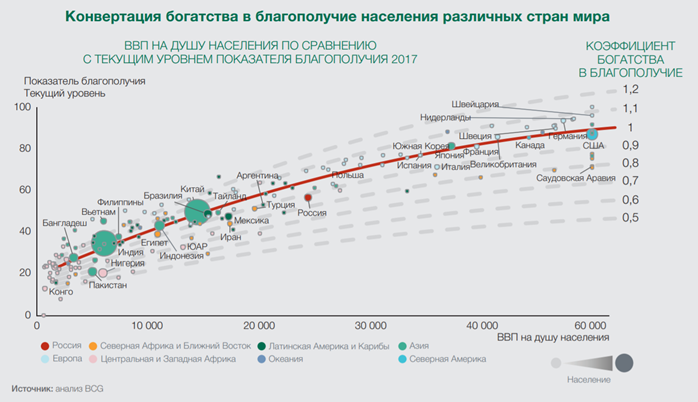
A key challenge most countries are facing today is to find a way to convert wealth into well-being for their populations. According to BCG studies, a country’s national welfare quite often does not directly correlate with its residents’ perceived well-being.

Within this study, the list of elements for a comfortable urban environment was defined based on the interpretation adopted in Russian practice:

  1. House and backyard are elements related to urban residents’ dwelling.
  2. Transit spaces are elements related to urban residents’ movements, either from one facility to another or inside a facility, and the protection of their safety in the course of such movements.
  3. Attraction spots are elements related to facilities and territories used by urban residents to spend time outside of their homes.

To identify strengths and areas for improvements in the urban environment, the experts analyzed Moscow versus 11 megacities in different continents that are comparable by income level and total population: Hong Kong, London, Mexico, New York, Paris, São Paulo, Seoul, Shanghai, Berlin, Singapore, and Tokyo. The competitiveness heat map of Moscow based on comparison results shows that, currently, the main competitive advantages of the Russian capital, compared to the other megacities, are a high level of safety, an attractive appearance, comfortable public spaces, and vast leisure opportunities. At the same time, the results Moscow demonstrates in the housing and utility sector are not the best, and the city is behind in terms of the quality and accessibility of pedestrian infrastructure. Besides this, Moscow does not utilize its investments in infrastructure effectively enough as a lever of influence on the perception and behavior of urban residents, in terms of its level of safety, attractive appearance and uniqueness, as well as in terms of its leisure, sports, entertainment and cultural opportunities.

Based on the three areas mentioned, a program was drawn up for the development of a comfortable urban environment in Moscow, which consists of 14 key initiatives.
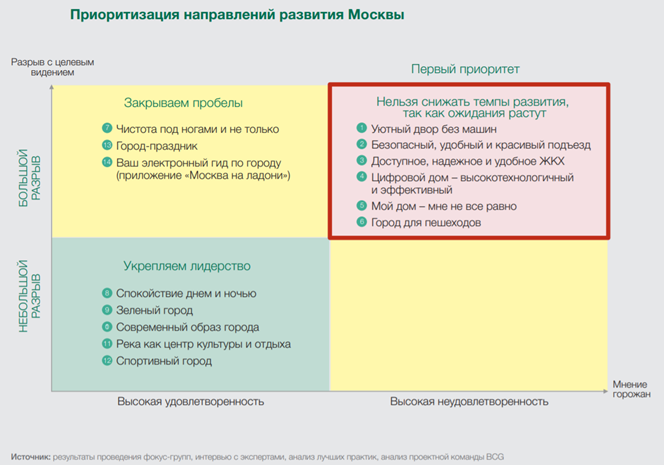
The competitiveness heat map compiled has proven to be an effective tool in assessing the current level of comfort in the urban environment and establishing a target vision for the city.

Anlytics on the topic

All analytics
Research
14 February 2019
Forecast of Social and Economic Development of the Russian Federation up to 2024

The Ministry of Economic Development of the Russian Federation has produced a forecast of social and economic development of the Russian Federation up to 2024 taking account of changes in external and internal conditions, dynamics of foreign economic environment, and global economic trends.

Research
26 March 2018
Proposals for Russia’s Migration Strategy through 2035

The report titled Proposals for Russia’s Migration Strategy through 2035 has been prepared by the order from the Centre for Strategic Research. The period that followed the disintegration of the Soviet Union proved to be challenging
for Russia from the perspective of politics, socioeconomics, demographics and migration. The unfavourable demographic trends and the declining and ageing of the population
were partially offset by an influx of temporary and permanent migrants from
other post-Soviet states. But numerous errors in the migration policy led to a decrease in Russia’s migration attractiveness, turning migration into a source of social tension and an instrument of political infighting.

Research
9 December 2019
World Happiness Report 2019

The 2019 edition in the series of reports published annually by the UN Sustainable Development Solutions Network explores how happiness has been changing over the past decades and how it has been influenced by information technology, governance and social norms.

Research
18 September 2019
Emerging Trends in Real Estate. The Global Outlook for 2019.

This report by PwC gives an outlook for the development of global real estate market in 2019. The authors assert that real estate investors are facing a test of nerve as concerns around economic uncertainty rise while, at the same time, they are forced to overhaul traditional business and valuation models in response to rapidly changing consumer demands.