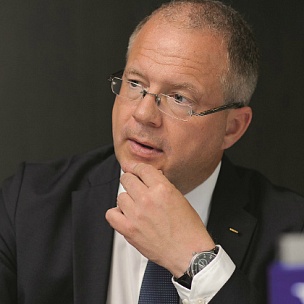
General Director of the Speech Technology Centre Dmitry Dyrmovsky discusses how biometrics will shape the future of aviation. The transformation is already underway, with certain smart elements being introduced at Yuzhno-Sakhalinsk and Saransk airports.
If passengers don’t have to queue, they spend more time in duty free
— How can biometrics solve problems for airports?
— We are seeing airports transform around the world in three ways. First, there is an attempt to reduce the amount of time spent on airport formalities, such as flight and baggage check-in, boarding passes, and passport and security checks. Biometrics both cut the amount of time these procedures take, and bring in money for airports: if passengers don’t have to queue, they spend more time in duty free. And the more time they spend there, the more money they spend.
The second point is comfort. We’ve already achieved a certain comfort level, and we don’t want to make any sacrifices. Everyone’s used to checking in online now, for example. Throughout the world, we’re all trying to use a lot less paper
The third focus is on ensuring that cutting back on formal procedures does not come at the detriment of security. Biometrics is a threat prevention tool.
After 9/11, as we all remember, the US brought in biometric passports, and Russia followed suit a little later. Then systems known as e-gates were introduced, making it possible to cross borders without encountering a border guard. These are essentially barriers which scan your face, passport, and fingerprints, and give you an electronic entry stamp in return. Solutions like these haven’t reached Russia yet, but they have already been launched in Germany and the US. They make it possible to structure passenger flows, minimize queues, and actually increase security levels. Border guards will often just check that your documents are in order. Do you think anyone really compares you to your passport photo?
Biometric systems control every stage and exclude the human factor. Airports have been their starting point, but we can expect to see them appear at road checkpoints and seaports in the future.
— Why has their starting point been airports?
— Airports bear the most responsibility with regard to security. There’s an economic effect at play here, also. An airport is like a shopping centre. Their task is to maximize passenger satisfaction.
Biometric solutions are not confined to single airports, either. The International Civil Aviation Organization (ICAO) recently produced a new set of regulations governing the transfer of biometrics between airports. Say you’re flying from Airport A to Airport B, and the first passes your data on to the second. When you arrive, you won’t be subjected to any serious security checks, since you’ve already been through them all at your starting point.
— We already have e-boarding passes in Russia, which operate using QR codes. Is this not enough? We always have our smartphones on us, and it takes just seconds to scan your pass.
— Sure, but with biometrics there will come a stage when we don’t need a boarding pass at all.
The classic method for identification is ‘I am what I have’ — documents, PINs, and so on. Biometrics work on the ‘I am what I am’ principle. It’s impossible to falsify or steal biometric data.
Smart phone identification doesn’t work because you can pass that QR code on to whomever you like. Airlines face a great financial liability for boarding the wrong person — a huge fine. In fact, airlines will even check visas before boarding passengers, because if they fly you over and you don’t have a visa, they’ll have to foot the bill for your flight back home.
This is the advantage of biometric systems. They benefit everyone. Airlines eliminate risks, the government improves security, and passengers receive a better quality of service.
When it comes to security, passengers are never notified
— We have a bright future with technology. I can see that. But what are you working on at the Speech Technology Centre?
— We’re developing a solution we call smart track. It’s a software platform which interfaces with airport systems, ticket reservation services, and loyalty programmes to create a complete digital profile for a passenger. As soon as you buy a ticket, your data will be stored in the ticket system. After checking in, your data enters the check-in system, and so on. We see every step, right up to boarding. As things stand, if a passenger is delayed at check-in, the airline doesn’t know whether he or she has arrived at the airport. With our system, this information will be available. Cameras at the airport entrance will log each individual who enters.
— Is the government aware of the benefits of introducing your system?
— Yes, absolutely. The processes are underway, but there is a lot of bureaucratic complexity. We need a lot of coordination between the Federal Air Transport Agency, border services, and security services. So at the moment, we only have certain aspects of smart track up and running. We started with security, with the initial identification system at airport entrances. This kind of system has already been installed at Yuzhno-Sakhalinsk and Saransk airports, and is currently being introduced at Nizhny Novgorod Airport. The system identifies blacklisted passengers. The identification process is carried out discreetly upon entering the airport, without the involvement of security staff, and so it doesn’t cause any additional delays.
— This raises a privacy issue: are people notified and do they agree with their biometric data being collected discreetly when they enter an airport?
— When it comes to security, passengers are never notified. You might be aware you’re passing through a metal detector, for instance, but you are never given an explanation of all the procedures being carried out. The authorities are under no obligation to explain how their security systems function, other wise they would be opening the door to any and all criminals. All these measures are set out in government decrees. It’s the law.
— Right, but we also have a constitution which guarantees confidentiality and transparency.
— That’s true. But it’s not quite so simple. Europe has adopted the General Data Protection Regulation (GDPR), for instance, which takes privacy to a new level. Information about how data is used and where it is stored is now completely transparent. But even within this law there are limitations where security issues are involved. The cameras at airport entrances do not currently store your data, but simply compare it against the blacklist.
Regarding smart track as a whole, no one will force you to hand over your biometric data at check-in or boarding. There will always be alternative routes where airline staff can manually check you in and stamp your passport. If you do wish to take advantage of the new system, then you are making a conscious decision to provide biometric data and consenting to its use. So there are no contradictions.
This is something people will gradually get used to, just as we came to realize that online check-in is more convenient and secure. Believe me, you give up a lot more of your personal data on social media.
Тext: Irina LI
Source: EEF 2018 Official Magazine