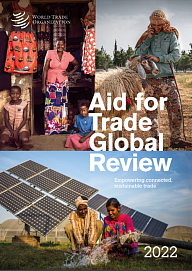
The publication presents the results of the 2022 joint OECD—WTO Aid for Trade monitoring and evaluation exercise. The authors analyze the latest trends in trade and the factors that have a direct effect on trade flows and global economy.
The Roscongress Foundation presents the salient points of the publication accompanied by fragments of broadcasts of relevant panel discussions from the business programme of international events held by the Roscongress Foundation.
The pandemic continues to affect trade and global economy.
A little more than two years after the start of the pandemic, trade and the global economy continue to be impacted by it and by the measures taken to control its spread.
WTO’s report says that the enduring impact of the pandemic on the global economy is high inflation, strained public budgets and raised concerns about access to essential supplies, such as food. These issues have been exacerbated by the crisis in Ukraine and the sanctions. The authors of the publication point out that trade facilitation is the most frequently cited Aid for Trade priority by all participants in the 2022 M&E exercise. Promoting export diversification, international competitiveness, building productive capacities and connecting to global value chains also rank highly among the trade priorities of developing countries and donors, in particular for landlocked developing countries and LDCs.
Awareness about climate change risks and their effect on trade is growing.
With greenhouse gas emissions at their highest levels in human history, environmental sustainability ranks high as an Aid for Trade priority, particularly among donors. Action to mitigate the effects of climate change is the main objective. Immediate and deep cuts in emissions are needed to limit global warming and to limit temperature rises to below 2°C. The analysts note that the development and trade strategies of developing countries increasingly refer to the environment. However, the transition to environmentally sustainable (green) growth is still at an early stage. Objectives are frequently presented in broad terms, with few targets against which to measure progress. Challenges in establishing sustainability targets and a lack of in-depth knowledge about the expected trade effects of climate change are among the issues cited as holding back progress. Together with limited access to funding, these factors impede further integration of environmental objectives into trade and development strategies.
Digital connectivity emerged as a factor for economic resilience.
Digital connectivity quickly emerged as an important factor for economic resilience during the COVID-19 pandemic, as lock-down measures limited person-to-person contact. The pandemic has accelerated e-commerce growth in countries at all levels of development, producing a connectivity boost among developing countries and LDCs. However, the rapid growth in demand for digital connectivity and services has exposed shortcomings in, for example, information and communication technology (ICT) infrastructure, regulation frameworks, affordability of connection and digital skills. These factors mean the digital divide remains wide, both within and between countries, with MSMEs and women particularly affected. Basic infrastructure remains a binding constraint for some LDCs. The continuing investment needed to upgrade ICT infrastructure places a fiscal burden on developing countries. The authors of the publication affirm that improvements are needed in the quality and scope of regulatory frameworks for e-commerce, and shortfalls in ICT skills need to be addressed because ICT plays an essential role in accelerating digital connectivity and facilitating e-commerce, which can help to address the world’s most pressing climate and environmental concerns. In turn, improved digital connectivity is fundamental to fulfil the promise of ICT for trade and development outcomes. Trade can help to bridge the gap and to reduce the cost of access to ICT services and goods.
Integrating women’s economic empowerment into Aid for Trade is now a priority for most countries.
The vast majority of both developing countries (92 per cent) and donors (90 per cent) include women’s economic empowerment as a priority in development strategies. Countries integrate gender issues into a wide range of instruments and policies, starting with their overarching development strategies. In particular, they develop dedicated instruments that address gender perspectives within a specific policy scope. However, integrating gender into trade policy remains an on-going challenge for most countries.
Gain more insights about economic development, trade, and possible ways to stabilize the economy during the pandemic and afterwards in the Trade policy, Economic progress, and StayHomeEconomy sections of the Roscongress Information and Analytical System, and about sustainable development, ecology, women’s rights, and ways in which digital technologies can help address these issues in the Digitalization, Gender parity, Climate Change, and Sustainable Development sections.