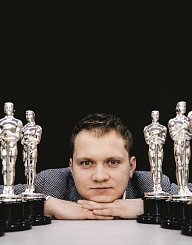
DENIS DOBRYAKOV,
28 years old.
WHAT: Artskills. A service that provides personalized gifts and souvenirs.
SCALE: Annual revenue: 100 million roubles. Average profit margin: 60%. Order volume: up to 4,000 gifts per day.
STARTUP: A garage, a laptop, and a second-hand photo printer.
CREDO: «In order to achieve something, you first need to learn something.»
His father said: «Don’t waste your time with this nonsense. Find a normal job.» Denis locked himself in the garage where he printed labels for wedding champagne and collected wall clocks with original faces. Together with his friend Sasha Tunikov, he launched a website promising to create unique gifts that could not be found anywhere else. Where they were not able to fulfil a customer’s request by making something themselves, they looked for suppliers. One day, they received an order for a gift for the Vice President of Rosneft: the solution was to present him with a bottle of whisky featuring a special gold engraved label.
Dobryakov managed to earn up to 20,000 roubles per month, providing a noticeable boost to his student grant. Finally, he graduated from Moscow Technological University (MIREA). He was now faced with the question: what next?
One day, Dobryakov shared his fascinating idea with his classmate, Artem Kudinov, over a beer. As a result, he recruited Kudinov as marketing director, and the company then brought in a small amount of development money for the first time. Vladimir Tunikov joined the team as its third member. He was not just Sasha’s brother, but also a talented developer in his own right.
«Money and resources are always scarce, but they can be secured one way or another,» reasons the founder of Artskills as he runs his hand over a digital printer that costs as much as a Moscow apartment. When the company started receiving more than 20 orders per day, the partners realized that it was time to automate the creative process. In particular, it was time to buy online editing software that would allow customers to produce a personal design for their chosen gift option in just 60 seconds. They found a German company that developed such software, but it cost an insane amount of money: 100,000 еuro.
Without a euro cent to their name, Denis and his team flew to Berlin to negotiate in August 2012. The Germans liked the four upstarts from Russia. They offered a 50% discount, but they got the following answer: «No, we’d rather pay the full price, but in instalments over time, as interest on the profits of Artskills.» Dobryakov had proposed the same kind of business deal (help us earn money, and you will earn money too) when he decided to acquire a printing machine and a laser engraving machine. The business was able to enter a period of rapid growth as soon as it freed itself from being dependent on eternally unreliable suppliers.
The next problem for the tormented entrepreneurs to overcome was a crisis of their own incompetence. It turned out that Artskills was receiving more orders than its employees were able to fulfil. Time to overturn the existing operating model. Dobryakov and Tunikov began to delve into the science of production management. They bought all of the books on the Japanese Kaizen system that were available on Ozon.ru, and they began to implement lean manufacturing principles in their business. As a result, ‘Mikhalych’, a program for calculating production operations that is able to issue clear instructions about where to get certain items and where to send them down the entire production chain, from the warehouse to the packing table, became the latest addition to the Artskills team. As Dobryakov explains, «Lean production, in fact, is a never-ending process. I myself am committed to continuous development. If I go through a day without learning anything new, then I feel very uncomfortable.»
He now has everything he needs: equipment, ‘Mikhalych’, and energetic employees that represent a new historical phenomenon: part hipsters and part technologists. But there was just one more hiccup: the company’s production capacity could handle up to a billion roubles’ worth of orders per year, but current sales accounted for only 100 million roubles. In search of new knowledge, Dobryakov last year enrolled in the Moscow School of Management SKOLKOVO. There he got an idea: increase sales by turning personal souvenirs into business tools. He christened his idea ‘Gifts for Business’.
Denis describes how it works by way of an example. Representatives of a large bank recently paid a visit to Artskills. They wanted to sell a payroll service, but by the time they left they had signed a contract for gifts. As Denis explains, «We told them how it was possible to increase sales by strengthening loyalty through positive emotions. For example, you can present a personalized calendar, a pen featuring the client’s name and surname, or a board game during negotiations.»
Does Dobryakov have any big goals? He points to a plush unicorn sitting on the shelf. The unicorn is a business symbol. It stands for a company with capitalization of 1 billion dollars. When Denis raised capital during his first investment round at Skolkovo, his company was valued at 600 million roubles. That’s when his pursuit of unicorn status began.
Ivan Prosvetov, Laboratoriya Odnazhdy, special article for SPIEF MAGAZINE