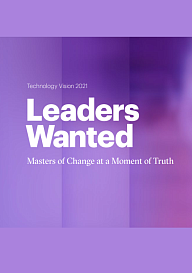
The study by Accenture is focused on leadership and technology trends, with an added emphasis on challenges faced by leaders because of the coronavirus pandemic.
The Roscongress Foundation presents the salient points of the publication accompanied by fragments of broadcasts of relevant panel discussions from the business programme of international events held by the Roscongress Foundation.
The pandemic has accelerated the formation of technology leadership.
Rapid digital acceleration during the pandemic has cemented technology as the cornerstone of global leadership. The gap between digital leaders and laggards grows by the day and committing to a wait-and-see approach will land companies on the wrong side of that gap. Leadership demands that enterprises prioritize technology innovation in response to a radically changing world. This is why 90% of business and IT executives surveyed by Accenture agree that to be agile and resilient, their organizations need to fast forward their digital transformation with cloud at its core.
The difficulties faced by leaders because of the pandemic sped up technology trends. And what started as an attempt to solve immediate problems during the pandemic has quickly become an opportunity to rapidly re-platform the enterprise and become an industry leader. For example, despite the collapse in the restaurant industry (with losses estimated at $240 billion), Starbucks managed to emerge as a leader.
Starbucks had a digital transformation well underway by 2020, and when the pandemic hit, that transformation evolved from a strategic initiative to a vital airbag. The company’s mobile app proved invaluable as contactless transactions rapidly became the norm. By August, three million new users had downloaded the app, and mobile ordering and drive-thru pick up combined accounted for 90 percent of sales. Starbucks used technology to reinvent its customer experience for a changed world, and when demand surged, it doubled down.
Now’s the time to rebuild the world better than it was before the pandemic, concentrating on sustainable development, the impact left on the environment, growing inclusivity, and more.
Even prior the pandemic leaders have been widening their vision of who their stakeholders are and ingraining those commitments into the fabric of their business. For example, in light of protests that brought awareness to racial inequality, Walmart underwent an audit of its diversity and hiring practice, prioritized relationships with minority-owned suppliers, and committed $100 million to establishing a center for racial equity.
With their accelerated digital transformations, enterprises can attack some of the deepest-set challenges the world faces. As efforts like sustainability and conscientious consumption become top initiatives, technology offers a foundation from which to achieve those goals.
When buying a product, the customer is now able to see its full production history. It’s possible to guarantee that sustainable material was used in the packaging, confirm the absence of allergens, be assured of ethical practices in production, and more. In the past, providing this level of visibility for any and every product would have seemed far-fetched. But emerging technology solutions are making it increasingly feasible, allowing companies to build trust with customers in unprecedented ways.
The authors of the report note that companies are no longer strictly competing for market share; they are competing to build their vision of the future, and financial success will only be one measure of leadership. Success will depend on their ability to accelerate and master change in all parts of their business, which in turn will be a direct function of the technology decisions they make today.
There are five technology trends for 2021 stemming from the effects of the pandemic and rapid technological change.
Accenture identifies five technology trends for 2021:
1. A new era of industry competition is dawning—one where companies compete on their architecture.
2. Growing investments in data, AI, and digital twin technologies are giving rise to a new generation of business and intelligence.
3. Natural language processing, low-code platforms, robotic process automation, and more are democratizing technology, putting powerful capabilities into the hands of people all across the business.
4. After the pandemic, it’s time for enterprises to transform remote work from an accommodation, to an advantage.
5. The global disruption of COVID-19 ignited a scramble for enterprises to reimagine their partnerships—and multiparty systems gained newfound attention.
For more information about possible ways to stabilize the economy during the pandemic, see the StayHomeEconomy section of the Roscongress Information and Analytical System, and the Digitalization, Labor Market, and Sustainable Development sections about digital technologies and related changes in the labor market and society.