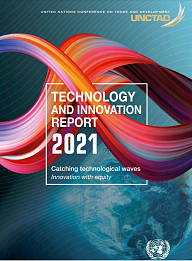
The report published by UNCTAD (United Nations Conference on Trade and Development) studies the impact of frontier technologies on countries depending on their incomes and level of development. The report covers 11 of such frontier technologies, i.e. key technologies of the future: artificial intelligence (AI), the Internet of things (IoT), big data, blockchain, 5G, 3D printing, robotics, drones, gene editing, nanotechnology and solar photovoltaic (solar PV).
The Roscongress Foundation presents the salient points of the publication accompanied by fragments of broadcasts of relevant panel discussions from the business programme of international events held by the Roscongress Foundation.
The United States and China are the primary providers of frontier technologies.
At present, the 11 frontier technologies covered in the report represent a $350-billion market which, according to UNCTAD forecasts, could grow to over $3.2 trillion by 2025. Many of the major providers of frontier technologies are from the United States which is home to major cloud computing platforms. China is also a major producer, notably of 5G, drones and solar PV. Importantly, for each of the technologies, these two countries are also responsible for 30 to 70 per cent of patents and publications.
There is a risk that the rapid development of frontier technologies will exacerbate inequalities.
Technological change affects jobs, wages and profits. Developing countries find it hard to catch the wave of frontier technologies. The primary constraining factors are demographic changes, lower technological and innovation capabilities, slow diversification, weak financing mechanisms, and constraints on intellectual property rights and technology transfer.
Frontier technologies carry socio-economic risks.
AI and robots can replace humans in a wide range of areas. Some estimates suggest that over the next 20 years, in Europe and the United States 30 to 50 per cent of jobs could be automated. Nevertheless, some kinds of intellectual activity such as those requiring empathy, ethical judgements, inventiveness, managing unpredictable changes, or making decisions based on understanding tacit messages will still have to be carried out by humans because such jobs cant be automated. Thus, frontier technologies initiate structural transformations but their impact on countries and societies will probably vary depending on countries readiness to the changes.
Frontier technologies are a prerequisite for closing gaps in economic development.
Whilst only a few countries currently create frontier technologies, it is essential that all countries have equitable access to the technologies to ensure global prosperity for all.
To assess national capabilities to equitably use, adopt and adapt these technologies UNCTAD has developed a readiness index. The index comprises five building blocks: ICT deployment, skills, R&D activity, industry activity and access to finance. Based on this index, the countries best prepared are the United States, followed by Switzerland, the United Kingdom, Sweden, Singapore, the Netherlands and the Republic of Korea. Notably, Russias index score is close to that of China (27th and 25th place in the rankings respectively). The economies least ready to technological change are in sub-Saharan Africa.
At present, the world is reaching the end of the deployment phase of ICT and starting the installation phase of Industry 4.0, involving an accelerating development of frontier technologies. The impact of this transition on between-country inequality depends on countries national policy trajectories, their participation in international trade, and their readiness to close the existing technological gaps. Policymakers should make frontier technologies contribute to increasing equality between countries and within countries.

For more information, see the special sections of the Roscongress Foundation Information and Analytical System: 4th Industrial Revolution, Digitalization, Artificial Intelligence, AI, Robotics, and Genetic Engineering about innovation, ICT, and digital technologies; and Economic Progress about economic development.