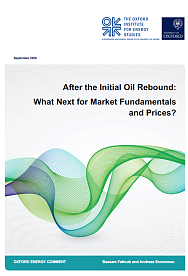
The Oxford Institute For Energy Studies has prepared a forecast study on the development of the oil industry and the impact of a number of factors, in particular, the COVID-19 pandemic on the oil market and oil prices.
The Roscongress Foundation presents the salient points of the publication accompanied by fragments of broadcasts of relevant panel discussions from the business programme of international events held by the Roscongress Foundation.
Oil price volatility remains low after the recovery
Following the sharp recovery in the oil price, which saw Brent increase by more than $16/b during the months of May and June 2020, the Brent price has been stuck in the narrow $40/b-$45/b range since July and despite the heightened uncertainty, volatility has been exceptionally low.
On the one hand, this reflects the fact that the recent price recovery was driven by improved market fundamentals both on the demand and the supply side and hence the current price range is well supported. On the other hand, the narrow price range and low volatility reflect a market that is not yet ready to move to a higher price range as the V-shaped recovery in demand seems to have now stalled as concerns over the recent resurgence in Covid-19 cases have resurfaced in many parts of the world.
In addition, demand and supply oil dynamics and the existing buffers in the form of relatively high OPEC+ spare capacity and the large build-up of crude and products stocks constitute additional caps on the oil price.
The pace of demand recovery and OPEC+ responses are the key dynamics that will shape market outcomes and determine in which direction, and how fast, the oil price will break away from the current range
Authors’ model indicates that the breakout will occur in Q4, but it will be gradual and limited on the upside. Also, the market seems more prepared to move to a higher rather than to a lower price range and has been waiting for some positive signals on the demand side, particularly from the US and India. A key reason for this ‘upward’ bias is that there is a belief that generalised lockdowns similar to what we have seen in March and April are not likely and therefore demand will recover even though at a slower pace. But a key premise underlying the upward bias is that OPEC+ cohesiveness and high compliance will be maintained, and this represents a fundamental shift from previous cycles.
The COVID-19 pandemic affects the pace of recovery in oil prices
A key question currently confronting the market is the time that it will take, or even whether, global oil demand will reach its pre-virus level. There is growing consensus that the next stage of the recovery towards the pre-virus levels may turn out to be slower than originally expected as uncertainty about the second wave of the virus persists and restrictions are reintroduced. Also, even if global oil demand reaches its pre-virus level of demand, many are of the view that COVID-19 had profoundly changed consumers’ behaviour and accelerated the pace of the energy transition away from fossil fuels, which will cause oil demand to shift to a slower growth path.
However, the jury is still out there. For instance, there is a strong belief that oil consumption related to mobility and car ownership will fall sharply as more people decide to work from home. On the other hand, the pandemic could induce a drop in the use of public transport and a preference for more private passenger vehicles. People could also avoid planes in favour of cars. Furthermore, while there may be a change in people’s purchasing habits through digital platforms, reductions in shopping trips could be offset by higher delivery truck miles. In short, while COVID-19 may have accelerated shifts in consumers’ behaviour, it is still too early to tell how durable these changes will be and whether new work and driving habits on their own will result in a massive reduction in oil demand.
For more information about response to the coronavirus outbreak and possible ways to stabilize the economy in the face of a pandemic, please see the Oil and Gas, Exploration and mining, COVID-19, and StayHomeEconomy.