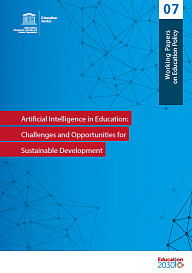
This paper, prepared by UNESCO, gathers examples of the introduction of AI in education worldwide, particularly in developing countries, analyses how AI can be used to improve learning outcomes, addresses the challenges and policy implications of introducing AI in education.
The Roscongress Foundation presents the salient points of the publication accompanied by fragments of broadcasts of relevant panel discussions from the business programme of international events held by the Roscongress Foundation.
AI technologies are used to ensure equitable and inclusive access to education
AI provides different groups of society, like people with disabilities, refugees, those out of schools, and those living in isolated communities with access to appropriate learning opportunities. For example, telepresence robotics allow students with special needs to attend schools at home or hospital, or maintain continuity of learning in emergencies or crises. In this way, it is able to support inclusion and ubiquitous access. One of the most important advantage of using artificial intelligence is collaborative learning, especially in situations where learners are not physically in the same location. AI also can help personalise learning through various ways.
These opportunities are starting to unfold in both developed and developing countries. Thus, in 2016 Chinese government launched a plan to become the largest pole of AI development in the world by 2030. China set its national AI strategy for education as part of this technological vision. In Latin America, several initiatives have been pushing the introduction of computers in education at a large scale in recent years.
In the context of a near future society empowered by AI, it is important to develop new skills to create and decode digital technologies
Businesses are generally quick to adopt AI-based solutions. This means an increasing demand for new types of jobs and skills that are linked to the use of AI in industry. As such, there is strong imperative for the education sector to respond in that curricula must be reworked and policies reformulated. However, no country in the world is genuinely ready for intelligent automation. Nevertheless, there is exemplary work being done by countries across the world to ensure that their education systems are promoting the acquisition of competencies required by an AI-powered society.
New programs are being introduced at different levels of education — in primary schools, in universities, and in additional courses. For example, Singapore also starts young in its effort to develop AI competencies amongst learners. In 2016, the country’s Info-communications Media Development Authority (IMDA) launched the PlayMaker Programme, which introduced robots to 160 preschool centres to develop very young learners’ appetite for and competency in robotics, programming and computer science through play.
Efforts of such countries can serve as starting points towards the development of a concerted policy framework for education’s response to AI.
The introduction of artificial intelligence in educational processes is associated with a number of challenges and risks
This paper highlights the following challenges that may arise when working with artificial intelligence, including development of comprehensive public policy on AI for sustainable Development, ensuring inclusion and equity in AI in education, developing quality and inclusive data systems, preparing teachers for AI-powered education and preparing AI to understand education, ethics and transparency in data collection, and so on. These aspects should be taken into account in policy-making, and this study can also help to take informed and appropriate policy responses.
For more information about Education and Artificial Intelligence development, please see the Artificial Intelligence, and Education.