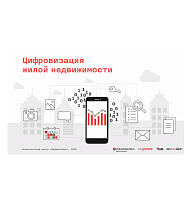
The Roscongress Foundation, Redmadrobot, and the Academy of Real Estate (ARE) have published a joint study of digital technologies used in residential real estate. The work studies the current state of the market for smart home systems and identifies barriers to this technology. The publication was prepared specially for the PROESTATE.Live International Investment Forum 2020.
Although the Russian market for smart home technologies is far behind that of Western economies, Russian users are demonstrating a constantly growing interest in smart home tools. Public authorities are trying to support the rising popularity of the technology by making attempts at creating industry standards and introducing new concepts such as smart utilities. At the present stage, these initiatives are aimed at popularizing smart metering systems and controlling emergency responses. The main barriers to smart technologies are their high cost and vulnerability of smart homes to cyber threats.
The Roscongress Foundation presents the salient points of the publication accompanied by fragments of broadcasts of relevant panel discussions from the business programme of international events held by the Roscongress Foundation.
Although the Russian smart home systems market is still at an early stage of development, the interest in this technology is rising both among users and public authorities.
Based on 2019 sales figures, Russian retailers report that smart home tools are growing in popularity as people are seeking resource efficiency, economy, and safety.
In March 2019, Russia introduced a smart city standard, containing, among other things, the concept of smart utilities. Some of the goals of the initiative are:
· to install smart metering systems,
· to install automatic services for monitoring the status of repair requests and controlling emergency responses.
In the near future, IoT systems will mainly be introduced as pilot projects. Mass integration of IoT into utilities is forecast for a later time — three to five years from now.
AI is one of the closest future trends in utilities. Elements of this technology are expected to raise the level of automation in the industry and help manage municipal facilities in a more efficient way.
According to J’son & Partners Consulting, starting from 2018, 3 to 5 million new devices are getting connected to the Internet in Russia every year. This trend is expected to continue until 2022, by which time the number of smart devices is forecast to exceed 40 million, while the market volume will reach 86 billion rubles.
Despite the growing popularity of smart home systems, there are many barriers to their mass installation, most notably the high cost of such tools and their vulnerability to cyber threats.
Often, smart home systems aren’t installed because it is hard to integrate them into the existing housing infrastructure. Also, builders are reluctant to spend money on these technologies.
The Russian Quality System (Roskachestvo) warns users that smart homes are vulnerable to cyber threats. Experts recommend that users should set strong passwords, enable two-factor authentication (2FA), install anti-virus software on their computers and smartphones, use VPN to protect their Wi-Fi, and regularly update their smart tools.
Video: https://roscongress.org/sessions/gorod-budushchego/search/#00:20:40.319
For more information about construction as a sector with a sizeable share in many economies, rising level of digitalization, and shifts in consumer sentiment in real estate, please see the Building and construction, Housing and utilities, Consumer sentiment, Cybersecurity, and Internet of Things, IoT special sections of the Roscongress information and analytical system.