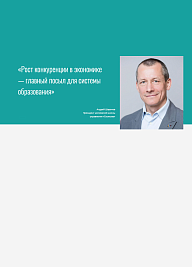
KPMG Mustread presents an interview with Andrey Sharonov , President of the Moscow School of Management Skolkovo, which reveals the role of business education in todays rapidly changing world.
According to Andrey Sharonov, in order for education to remain relevant, it is necessary to abandon the idea of teaching a young man or a girl a specific specialty, due to the fact that they are simply changing very rapidly. Therefore, in the light of recent events, they began to pay attention to the existential skills that are needed throughout life. There is a 4K concept. It says that a person needs to be taught four key competencies: Communication; Cooperation; Creativity and Critical Thinking.
Speaking about Russian education, in order to remain competitive and efficient, it is necessary to change the low competition in the economy. A significant part of the Russian economy is outside the laws of competition. People do not associate their future with the quality of education they receive. Growing competition in the economy and the understanding that a good education is a social elevator are the main messages for the education system. Andrey Sharonov notes that not only in Russia, but also around the world, a certain trend is emerging people go to business schools for making connections. Surveys of American business schools graduates show that they put the quality of connections with people they studied on the first place. Not the quality of contacts with people who gave lectures to them.

«I used to mistakenly think that good students go to good teachers. As it turned out, things are completely different: good teachers go to good students. And when I talk to our professors who come to us from Cambridge, London Business School, IESE, Chicago Booth, IMD, INSEAD, some of them say, You have a very interesting student body. And yes, it is true. For the sake of our students, they are ready to fly to Moscow several times a year, » - Andrey Sharonov, President of the Moscow School of Management Skolkovo.
In the field of education, the real differentiator today is reputation. Founders and management continue to invest large funds and efforts, look for the best teachers and select students, a school grows gradually, but slowly, but at some point, a pyramid turns over, and a number of loyal, grateful and successful graduates becomes significant. Now, most people come to us on the recommendation of other graduates. Andrei Sharonov assures that there are a number of reasons why people who built their businesses in the late 90s early 2000s feel some kind of lack of managerial competencies and systemic knowledge. The first is the school creation history. The second one is the Russian specifics associated with the fact that entrepreneurship was legalized in the Russia in 1986, when the law «On individual labor activity» appeared. Andrei Sharonov assesses international ratings and accreditations as quality standards that are necessary to understand which of the 15 thousand business schools in the world to cooperate with. If the ratings do not include the school of your choice, you might switch to others.
Andrey Sharonov believes that the attitude to MBA is changing across the globe, both over time and with the development of business education. According to research results, Russian employers award a good bonus to employees for having an MBA degree. Expert assessments have shown that there is a large number of studies that record the difference in interaction with young people. Teenagers reacts much more sharply to some public initiatives, especially if they are related to ecology or environmental protection. Generation Z did not feel the need at the start of their lives, they had no need to provide for themselves from an early age, so money did not become the most important value for them. Andrey Sharonov also highlights an important topic related to leadership. He believes that many are mistaken when they highlight the figure of a leader, forgetting that someone cant become a leader without followers. Another important point, leadership is a process: as a rule, there are years of work behind it. Leadership is not hierarchical and, more importantly, is very contextual. There are two basic patterns: first, when people are afraid to surround themselves with ambitious, talented people, because they see them as a danger from the very beginning. Another variety is the position when you sure that only strong and excellent specialists should be around you, and, of course, after a while youll meet with the fact that someone begins to be comparable to you in leadership qualities. According to Andrey Sharonov, a sign of real leadership is to find your place, but not to grab it with your teeth.
The full interview: https://mustread.kpmg.ru/interviews/rost-konkurentsii-v-ekonomike-glavnyy-posyl-dlya-sistemy-obrazovaniya/
We also invite you to see other materials posted in special sections of the Roscongress Information and Analytical System Entrepreneurship, Education, StayHomeEkonomy and Human Capital, dedicated to the development of entrepreneurship in Russia, as well as the training of highly qualified personnel.