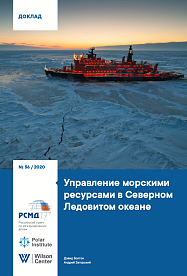
The RIAC (The Russian International Affairs Council) report reviews mechanisms to improve marine resource management in the Arctic and offers practical recommendations to design a more effective central Arctic Ocean marine resource management system.
Roscongress Foundation analysts highlighted the main theses of this research, accompanying each of them with suitable fragments of video broadcasts of panel discussions held as part of business programs of the key events hosted by the Foundation.
The past decade has shown an increase in high-level attention to ocean issues. Politicians are increasingly aware of the need for greater cooperation between states and stakeholders in addressing ocean issues. At the same time, they are ready to take the necessary measures.
In response to the intensification of human activity in the Arctic Ocean, states have created a certain governance architecture. The Arctic Council, established in 1996, has become an important forum within which coordination and exchange of the Arctic Ocean situation analysis results is carried out, and the policy of states is formed. The Council implements numerous projects and programs to address ocean-related issues.
The Arctic Council adopted the Protection of the Arctic Marine Environment Strategic Plan. The plan provides for the implementation of 40 strategic actions aimed at achieving four strategic goals:
Goal 1. To expand knowledge of the Arctic marine environment, to continue monitoring and assessing current and future impacts on Arctic marine ecosystems.
Goal 2. To conserve and protect ecosystem functioning and marine biodiversity to enhance their resilience and provide ecosystem services.
Goal 3. To promote the safe and sustainable use of the marine environment, taking into account the cumulative impact on it.
Goal 4. To enhance the economic, social and cultural well-being of Arctic residents, including indigenous peoples, and strengthen their adaption to changes in the Arctic marine environment.
The study provides examples of other projects in international activities in the Arctic ocean. Thus, in 2030 Agenda for Sustainable Development, adopted by the UN General Assembly in 2015, the following goal is spelled out: «Conservation and rational use of oceans, seas and marine resources for sustainable development.» In addition, negotiations have begun under the auspices of the United Nations to develop (based on the 1982 UN Convention on the Law of the Sea) an international legally binding instrument on the conservation and sustainable use of marine biological diversity in areas beyond national jurisdiction.
In short and medium term, it is possible to improve both the independent activity of the Arctic Council on the marine environment management, and in coordination with other organizations.
According to the authors of the study, the Arctic Council can more actively use the established cooperation with various intergovernmental organizations in interests of effective Arctic marine environment management. For example, the Arctic states can use the Council’s site to agree on common positions and jointly promote them in other intergovernmental organizations, such as the International Maritime Organization.
Many observer states have experience in ecosystem management in waters under their jurisdiction. The study notes that the Arctic Council could involve them more actively in planning and conducting scientific research, as well as in developing recommended measures.
In order to create an international regulatory regime that meets the requirements of establishing a mechanism for scientific research and long-term management of the marine environment, a more effective ecosystem management architecture is required in the Arctic Ocean, especially in its Central part.
The intensification of human activity in the Arctic Ocean, especially in its central part, will require the creation of a new element of the management architecture — a body for marine environment managing, capable of taking decisive measures based on scientific recommendations and proposals for their implementation. The new structure can be created both under the auspices of the Arctic Council and outside of it.
The main advantage of creating a marine environment management mechanism under the auspices of the Arctic Council or giving the Arctic Council the authority to perform the functions of such a body itself is that the Council is already a recognized organization with its own members and a polished functioning mechanism. During its existence, the Council has proven its ability to develop and take on new functions.
As human activities expand in the coming years, the implementation of these ideas will allow the Arctic states to establish an effective regime on the basis of which they will be able to effectively manage the Arctic marine environment. It is also important that the formation of this improved institutional architecture would become a common project for interested states, the implementation of which would help to reduce geopolitical tensions that have recently arisen in the Arctic.
See other materials posted in special sections of the Roscongress Information and Analytical System Arctic, Environment, Economic Progress and Sustainable Development, dedicated to the possible development of promising areas for the Arctic development, as well as achieving the goals of sustainable development and economic growth.