
Deloitte presents its 2020 Global Human Capital Trends reportthe latest in its series of annual reports started in 2011.
The past decade has been marked by radical change, by a «newness» that has evolved at a pace that can only be described as exponential. As the world enters into a new decade, the question for organizations is how they can leverage the environment that technology creates to humanize the world of work. According to Deloitte, by recognizing the possibilities of that environment, organizations can chart a path forward to embrace one of the greatest paradoxes they face today: Can organizations remain distinctly human in a technology-driven world?
The Roscongress Foundation presents the salient points of the publication accompanied by fragments of broadcasts of relevant panel discussions from the business programme of international events held by the Roscongress Foundation.
In just a few short years, the concept of the social enterprisean organization whose mission combines revenue growth and profit-making with the need to respect and support its environment and stakeholder networkhas grown from an intriguing new idea into a concrete business reality.
Driving the social enterprises accelerating momentum has been a continuing societal shift toward individual empowerment and advocacy in workers relationships with their employers. In 2018 and 2019, people went on strike in numbers not seen since the 1980s to demand changes ranging from better working conditions to gender pay equity.
These mounting societal expectationscombined, in many countries, with greater worker power due to low unemployment rateshave put human concerns front and center for organizations and society.
At the same time as these human concerns were playing out, another equally powerful phenomenon was underway: an intense focus on technology as a primary driver, if not the primary driver, of enterprise value.
A view that fuses the human and the technological can enable people and organizations to transcend the most challenging conflicts that exist in organizations today.
Last year, Deloitte put out a call to action on this front by asking organizations to «reinvent with a human focus.» But as the world enters into a new decade, Deloitte analysts assert that organizations need to go one step further. Instead of asking how to humanize a work environment inundated by technology, the deeper question for organizations is how they can leverage the environment that technology creates to humanize the world of work and remain distinctly human in a technology-driven world.
The analysts suggest that organizations consider making three bold shifts:
• Fostering belonging amid a desire for individuality.
• Creating security in a world of reinvention.
• Taking bold action in an age of uncertainty.
These three shifts represent a new set of attributes that characterize what it means to truly become a social enterprise at work:
• Purpose: An organization that doesnt just talk about purpose, but embeds meaning into every aspect of work every day
• Potential: An organization that is designed and organized to maximize what humans are capable of thinking, creating, and doing in a world of machines
• Perspective: An organization that encourages and embraces a future orientation, asking not just how to optimize for today, but how to create value tomorrow
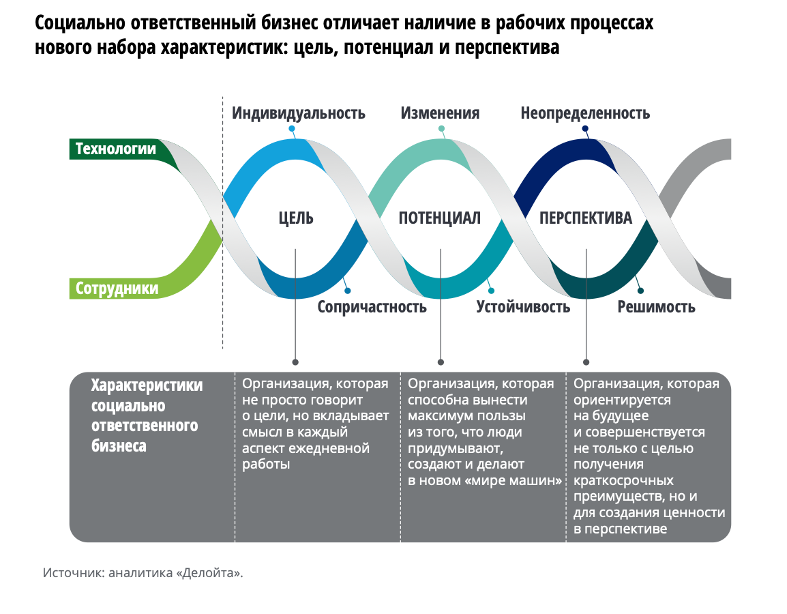
To embody these attributes takes a high degree of change. Deloitte analysts use the framework of purpose, potential, and perspective to organize the discussion of this years human capital trends. These trends look across the components of an organizations infrastructurefrom the systems that guide process execution to the metrics that track and measure strategic progressand offer suggestions on ways to embed purpose, potential, and perspective into the very core of how they are designed and executed.
For more information about possible ways to stabilize the economy during the pandemic, please see the StayHomeEconomy and COVID-19 special sections of the Roscongress information and analytical system, and the Labour productivity gains and Entrepreneurship sections about measures aimed at stimulating economic progress.