The study presents the expert opinion of specialists from Arthur D. Little on key modern challenges for aviation and promising areas of response to these challenges. Analysts at the Roscongress Foundation have identified the main points of this study, accompanying them with relevant video broadcasts of panel discussions held as part of business programmes of key international events held by the Foundation.
1) The aviation crisis associated with the COVID-19 pandemic is the largest in history, the consequences and scale of which are difficult to overestimate
The speed and scale of the devastation in the aviation industry caused by COVID-19 has been unprecedented. The crisis has hit the industry at the worst time of the year during peak booking season causing a severe short-term cash crunch and many likely supply chain casualties. Whats more, the duration of the crisis may be longer than initially predicted: the pandemic is spreading across regions, and many predict that there will be subsequent waves of the virus until a vaccine-based solution is fully implemented. Demand is unlikely to return to current levels for at least a few years, if at all.
Video: roscongress.org/sessions/ekonomika-rasstoyaniy/search/#00:59:52.703
2) The COVID-19 crisis in the aviation industry is not self-contained: it overlapped with existing problems in the industry
Although the industry as a whole was thriving before the crisis, in many ways it was already in a precarious situation due to underlying threats:
-
Unbalanced profit sharing across the value chain, particularly at the expense of the airlines.
-
Rapidly growing challenges to further globalization of economies and unfettered growth of travel due to environmental concerns.
-
Fundamental constraints on operational and business agility within and between ecosystem players (airlines, airports, ATC, handling, etc.) due to a patchwork of complex regulations, which have increased over time.
3) When making plans to overcome the crisis in the aviation industry, we must take into account the key trends of our time
When approaching recovery, companies should already be looking towards their longer-term positions in terms of regrowth. Experts at Arthur D. Little see four key trends affecting both recovery and regrowth, which have been accentuated by the crisis: changes in demand and consumer behaviour; changes in the competitiveness of various business models; regulatory policy changes; and acceleration of technological development in the industry.
4) Scenarios for further development of the aviation industry determine ways out of the crisis
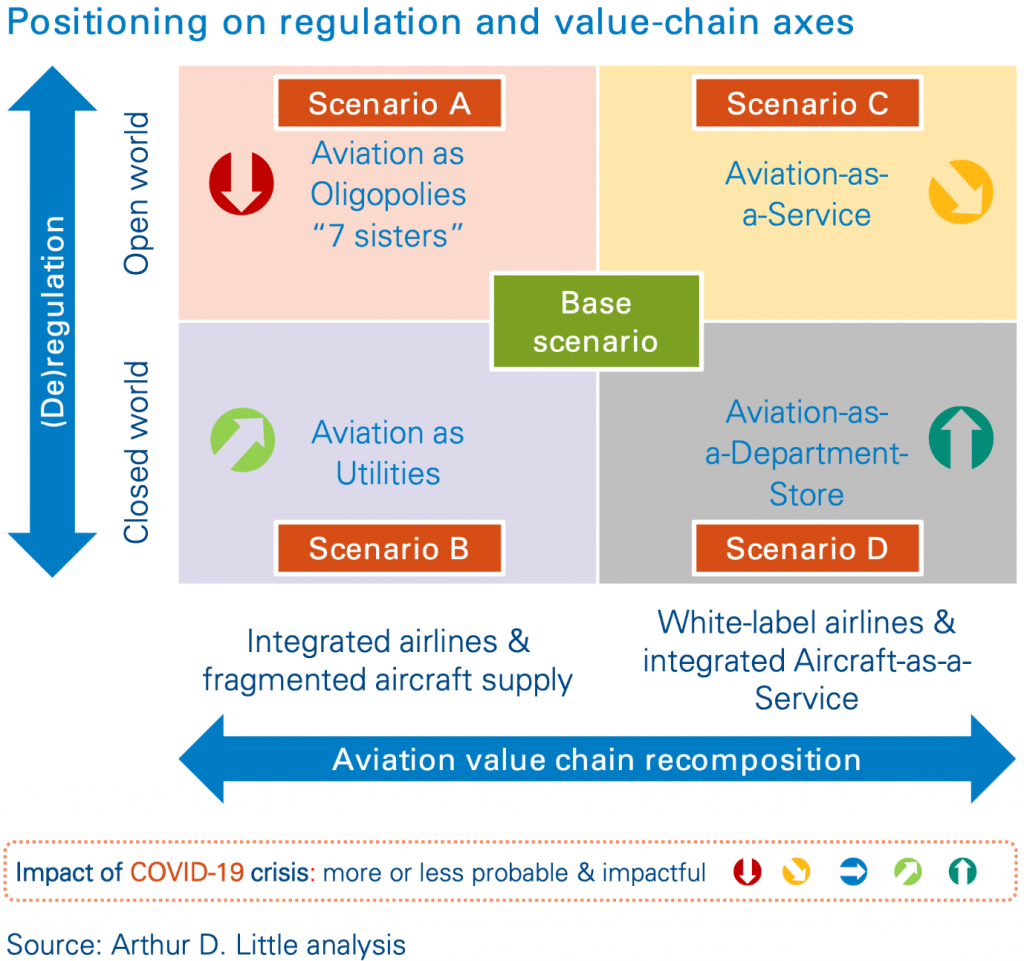
Experts from Arthur D. Little identified the expected base scenario and four alternative scenarios for the development of aviation (scenario A: Aviation as Oligopolies; scenario B: Aviation as Utilities; scenario C: Aviation as a Service; scenario D: Aviation as a Department Store), which depend on the scope of regulation and the extent to which the aviation value chain needs to be rearranged. In their opinion, the most likely scenarios, under the current conditions of deglobalization, are scenarios B and D:
-
B: Aviation as Utilities: Industry structure is similar to how it is today, but with strong regulation limiting growth and margins; infrastructure service providers are strictly regulated and prevented from diversifying into new profit sources; aircraft providers focus on green and autonomous products to make a difference.
-
D: Aviation as a Department Store: Airlines retain customer ownership but become vehicles for third-party media brands; infrastructure service providers are regulated to focus on public service; air transport service providers supply aircraft from total fleet providers and managers, which capture an even greater profit pool.
5) All aviation players should globally rethink both the industry as a whole and its place in it in the future
Despite the damage caused by the crisis, the upside is that it has also underscored the urgency for a more radical rethink something that was already needed before the crisis. Companies approaching recovery and regrowth should:
-
Develop a forward growth strategy that adequately considers future changes in the industry, especially in terms of demand, consumer behaviours, changes to industry ecosystem roles, new business models, new regulatory requirements and accelerated technology disruptions.
-
In the short term, develop scenarios for, and responses to, how the recovery phase will develop, considering different assumptions according to the profile, geographical differences, regulatory changes, etc.
-
In the medium term, consider how to position themselves to exploit opportunities in a reinvented industry.