BCGs Center for Macroeconomics has produced a study in the form of a presentation with detailed instructions for entrepreneurs on how to respond to COVID-19 crisis. The publication also provides examples of best practices adopted across countries to improve the business sectors resilience.
The Roscongress Foundation presents the salient points of the publication accompanied by fragments of broadcasts of relevant panel discussions from the business programme of key international events held by the Roscongress Foundation.
1) COVID-19 is rapidly changing the global economy: three scenarios for the crisis
· A V-shaped scenario depicts a classic economic shock, where growth eventually rebounds
· In a U-shaped scenario, there is some permanent loss of output after the initial shock
· An L-shaped scenario signals real structural damage, with a significant impact on growth
The crises associated with prior epidemics, including SARS, the 1968 H3N2 («Hong Kong») flu, 1958 H2N2 («Asian») flu, and 1918 Spanish flu, were all V-shaped. However, the scale of the COVID-19 pandemic makes one feel worried lest the recovery path might be different this time.
Video: Pandemic Preparedness as a Condition of Sustainable Economic Growth in the Asia-Pacific Region (02:25); speaker: Anna Popova, Head, Federal Service for Surveillance on Consumer Rights Protection and Human Wellbeing (Rospotrebnadzor)
2) To minimize the impact of the pandemic, companies must take steps to protect their employees and managers
According to BCG, people priorities must be front and center in crisis management. As leaders attempt to respond to the crisis, seven core priorities are essential to decisively combating COVID-19. The first two priorities are connected with the companys responsibility for people health; the third and the fourth are aimed at raising workforce readiness and mitigating people risk; the fifth and the sixth are meant to foster the communication and support culture; and the seventh one is about digital readiness.
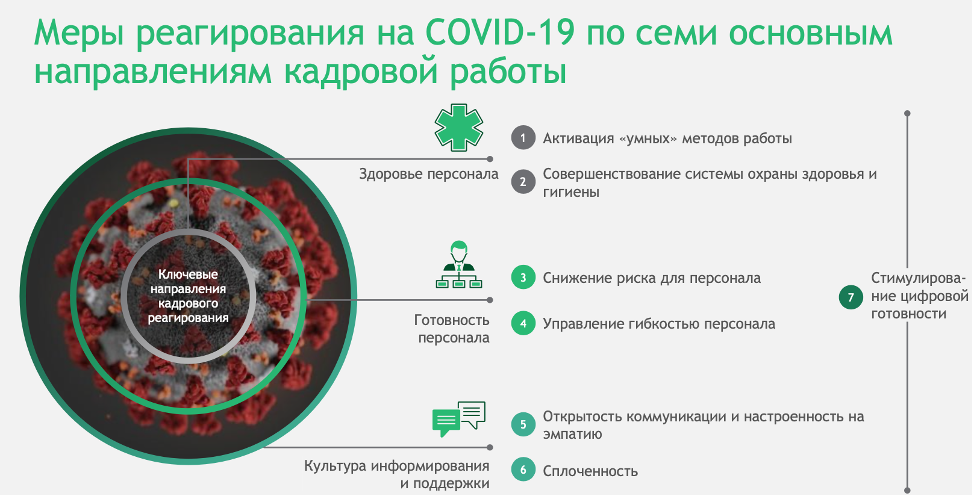
1. Accelerate smart work (establish remote working, replace in-person with virtual meetings, set up virtual agile teems, adapt travel policies)
2. Enhance health and hygiene (adopt new hygiene and health habits, improve workplace hygiene, support and monitor employee health, guarantee social distancing)
3. Mitigate people risk (identify and support critical roles, decrease risk exposure, e.g. split teams, contingency staffing and planning)
4. Manage workforce flexibility (analyze business impact on workforce, adapt existing workforce to current situation, adjust hiring to temporarily adjusted demand, manage individual employee downtime)
5. Communicate openly with empathy (identify communication channels, organize a clear communication structure, pass information to employees in a timely manner, educate employees and managers on COVID-19)
6. Stand together (prepare your leaders, support employees and their families, build and enhance ecosystems)
7. Speed up digital readiness (identify need and deliver needed hardware, provide appropriate software and tools, train your people on digital readiness, build technology support teams)
Video: A New Generation of Entrepreneurs (22:46); speaker: Andrey Shutov, Founder, Factorial Group
3) Best practices of responding to COVID-19 challenges for the seven key people priorities already exist
Many corporations have started accelerating smart work. For instance, Apple Inc. CEO Tim Cook offers employees at most offices an opportunity to work from home. Many governmental bodiesincluding the European Commission and the European Parliamenthave also switched to teleworking and virtual meetings.
To manage workforce flexibility, UniCredit uses advanced analytics to simulate impact and identify crisis management measures. Strategic workforce planning delivers real-time information on highly dynamic scenarios.
BCG set up an international Rapid Response Teama clear evidence of the companys commitment to openness and empathy. Microsoft executive vice president Kurt DelBene personally sent emails to all employees and informed them about remote working, travel restrictions, and prevention measures.
Google CEO and CFO called on employees to support one another during this difficult time and to uphold the companys important role in society.
Many companies are striving to demonstrate their solidarity and readiness to fight for their customers, clients, and employees. Microsoft promised to pay full salaries to 4,500 service providers regardless of actual hours worked. Amazon announced a fund of $5 million for individuals affected by COVID-19. Alibaba set up a fund of $144 million for medical supplies for the hard-hit Hubei province.
Video: Biosecurity: Current Projects and Opportunities for Cooperation (15:58); speaker: Abdoulaye Yéro Baldé, Minister of Higher Education and Scientific Research, Republic of Guinea
For more information about policy responses to the coronavirus outbreak and possible ways to stabilize the economy during the pandemic, please see the COVID-19 and StayHomeEconomy special sections of the Roscongress information and analytical system.