Methodology
Between late October and mid-November 2019, PricewaterhouseCoopers (PwC) polled 1,001 people from various Russian companies. The representative sample included entrepreneurs born in 19801991 and 19571963 who represented small, medium or large businesses. The survey covered all industries and all Russian regions. The survey was conducted by means of phone interviews under conditions of confidentiality.
Business environment in Russia in the 90s
The majority of the participants of the survey believe that doing business in Russia in early 90s was fraught with difficulties. Overall, 57% of respondents said they faced problems. Meanwhile, 31% think that it was easy to do business in the 90s.
In the publication, the results of the survey are viewed from two angles. First, generalized data is given, and then the responses are broken down into two sets according to age groups (60-year-old people who were doing business in the 90s vs todays 30-year-old entrepreneurs).
When seen by age groups, responses form a different pattern. In the 60 years age group, 70% of respondents have a negative view about business climate in Russia in the 90s, while in the younger group the corresponding share is 54%.
Comparison between business conditions in the 90s and today
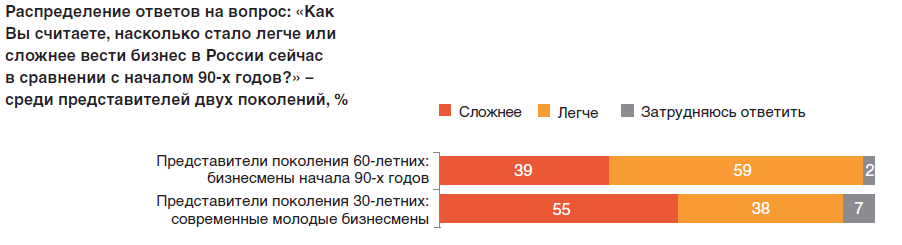
Opinions about changes in business climate over the past 30 years are split fairly evenly. While 42% of respondents think that the ability to do business in Russia has improved, 52% have the opposite view. Seen by age groups, the results are slightly different. Over a half of the 60-year-old respondents who were actually engaged in entrepreneurship in the 90s are convinced that it has become easier to do business in Russia. However, every second young respondent believes that the business climate has gotten worse over the last 30 years.
Those who speak about positive changes say that more services are now available, criminal organizations have subsided, and there is more opportunity.
Deterioration in business conditions is associated with high taxes and administrative barriers.
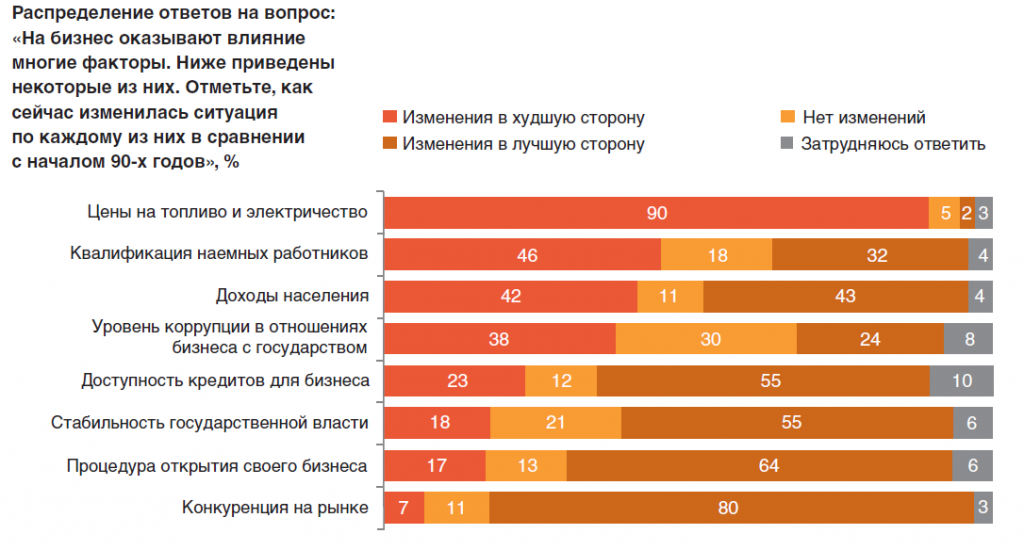
Speaking about specific negative changes, respondents also cite higher fuel costs, lower qualifications of employees, low household income, and widespread corruption. Positive changes include political stability, increased competition, simpler procedure for launching a business, and availability of loans.
Changes in business communitys qualities over the past 30 years
When asked how Russian business has evolved over the past 30 years, respondents mostly say that business in Russia has become far more professional and law-abiding and is now making a greater contribution to the national economy. Nonetheless, at the same time, respondents think that the business communitys commitments to social respondibility either have not changed much or have even backtracked.
A prominent positive trend is the growing empowerment of women in business. A vast majority believe that women in Russia have received more opportunities to engage in business in the past 30 years. The percentage of respondents who gave such an answer is higher in the younger age group.
Concerning the heritage of the 90s, as few as a half of respondents think that the experience of 30 years ago can be useful for doing business in the current conditions. Notably, representatives of the 60 years age group more often tend to believe that their past experience will help succeed in running a business today. Among the younger generation, less than a half of respondents share this view.
Forecast for the future of Russian business
The respondents are fairly optimistic about the future of Russian business. Over a half of the participants of the survey are convinced that the next 30 years will see Russian business evolve in a positive direction. They think that IT, the power industry, and trade are likely to develop the most rapidly in the next 30 years.
For Russian business to progress, respondents believe, it is necessary to relax regulation (in the sphere of auditing and reporting), reduce tax burden, increase state support (such as tax benefits, subsidies, and funding), improve the qualifications of staff, and fight corruption and cronyism.