Invest in Russia — invest in Russian regions!
All analytics

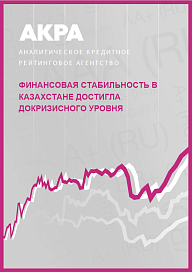
Financial stability in Kazakhstan has reached its pre-crisis level

Research
23 November 2018
Финансовая стабильность в Казахстане достигла докризисного уровня
Source
Release date
08/21/2018
Open PDF

The experts from the Analytical Credit Rating Agency (ACRA) assess the financial market of Kazakhstan using their own index named ACRA SFSI KZ (Structural Financial Stress Index for Kazakhstan). This index measures financial stability of the country and assesses its vulnerability to specific risks by aggregating information regarding maturities and currency profile of assets and liabilities of economic agents (financial companies, non-financial companies, population, and state). Like in many other oil-exporting countries, in Kazakhstan the currency risk is stronger than the interest rate risk, and the level of financial system stress depends on the FX rate volatility rather than the spread of interest rates.

In early 2018, ACRA SFSI KZ continued sliding and reached 0.52 pts by the end of 1Q2018. The index is now very close to its pre-crisis level: in 2010–2013, its value was equal to zero. The growth of financial stability in the first half of 2018 was due to, first, an absence of tenge exchange rate fluctuations and a low interest rate spread, and second, due to divergent trends in the currency and liquidity imbalance.


Currency imbalance in the country’s economy has shrunk, mainly because it has decreased in the financial sector. Conversely, the liquidity imbalance has increased, primarily due to its growth in the non-financial sector. According to ACRA analysts, in the second half of 2018, possible risks for the financial system of Kazakhstan include a growing demand for foreign currency and an increasing imbalance in the economy, while the liquidity imbalance isn’t expected to change much, provided that there are no considerable external shocks.
Anlytics on the topic

All analytics
Research
8 June 2020
Strong capital and stable funding balance the expected deterioration of the loan portfolio. Sberbank: Credit analysis

In this work, the Analytical Credit Rating Agency (ACRA) examines the distinctive features of Sberbank which ensure its balanced and stable functioning in a worsening economic situation shaped by the coronavirus pandemic and the global oil crisis.

Research
4 September 2022
World Development Report 2022: Finance for an Equitable Recovery

This report by the World Bank examines the effects of the crisis caused by the pandemic and studies the central role of finance in a robust and equitable economic recovery.

Articles
31 October 2019
Network Human Capital of Millennials as a Driver of the Digital Economy Development

The article reveals the features of the formation of network human capital. The characteristic of new network properties of human capital of Millennials in modern economy is given. The main trends in the transformation of employment and new digital competencies of Millennials in the use of Big data. The provision on capitalization of investments in network human capital is proved. The specificity of the activity of Millennials in social networks is shown. The tendencies of transformation of financial markets in the conditions of digital economy are revealed.

Research
8 June 2020
Financial and Economic Crises of Recent Decades and their Impact on Russian Economy

In the article «Financial and economic crises of recent decades and their impact on the Russian economy» experts of the PRIME Economic Information Agency note that the economic crisis cannot be prevented, but there are ways to mitigate its impact on the country’s economy.