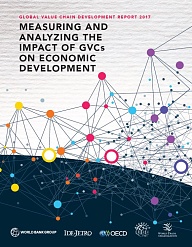
The importance of the phenomenon of global value chains (GVCs) has stimulated researchers from the International Bank for Reconstruction and Development (part of the World Bank Group), the World Trade Organization (WTO), the Organisation for Economic Co-operation and Development (OECD), the Institute of Developing Economies (IDEJETRO), and the Research Center of Global Value Chains of the University of International Business and Economics (RCGVC-UIBE), to develop statistics and analysis based on the value added in trade. The GVC phenomenon also demands that researchers analyze the discrete tasks or phases in the global production process. Data are now available on the value added traded among major economies during 19952014.
In recent years, GVCs have gained much importance because they help integrate developing countries into global trade and increase productivity. Some countries, however, have benefited more than others. This report analyzes the newest data to help policymakers and other interested parties grasp the growing complexity of global trade and consider strategies that can make GVCs more inclusive. Besides, the experts identify the factors that determine the degree of countries integration in GVCs and ways to maximize the benefits of GVCs.
Global value chains (GVCs) break up the production process so different steps can be carried out in different countries. Todays official statistical information systems designed to measure economic activity have struggled to keep pace with changes in global economy but in the end they dont reflect reality as clearly as calculations based on GVC data do. Conventional measures of trade measure the gross value of transactions between partners and so are unable to reveal how foreign producers, upstream in the value chain, are connected to final consumers at the end of the value chain.
This first Global Value Chain Development Report draws on the expanding research that uses data on the value added in trade. Its main objective is to reveal the changing nature of international trade that can be seen only by analyzing it in terms of value added and value chains. This report highlights how shifting the analysis to value added radically changes the picture.
.png)
This publication has been posted in the Roscongress Information and Analytical System on the recommendation of the Roscongress Foundation expert community.