Invest in Russia — invest in Russian regions!
All analytics

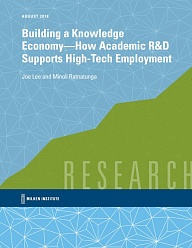
Building a Knowledge Economy – How Academic R&D Supports High-Tech Employment

Research
7 September 2018
Построение экономики знаний: как теоретические НИОКР поддерживают занятость в высокотехнологичных областях
Source
Release date
08/01/2018
Open PDF

Today, universities play an increasingly important role in determining a region’s capacity for innovation and its ability to transform new ideas into economic activity and commercialize them. Not only do they educate the local workforce creating human capital, and produce intellectual property, but they also contribute indirectly through their basic research activities. While not of immediate commercial value, these foundational research activities help create and advance industries in unpredictable ways.

Understanding whether innovative industries in the high-tech sector benefit from R&D activity at regional academic institutions would be useful when assessing the tools available for technology-based economic development strategies. This empirical analysis of the relationship between research activity and high-tech employment aims to inform policymakers interested in the long-term capability of regions to sustain an economic base in knowledge-based industries.

To understand the connection between university research and regional economies, Milken Institute experts focus on research spending at universities and its relationship to employment in the region’s high-tech sector.

The key findings of the analysis are:

  • the net effects of academic R&D expenditures on high-tech employment are positive in the long run, suggesting R&D funding is an investment in the regional innovation ecosystem;
  • technology transfer offices that facilitate the commercialization of academic R&D can be a mechanism to capitalize on untapped innovation;
  • career development centers, placement services, and collaborative partnerships may increase spillover effects from universities by creating more opportunities for informal knowledge exchange.

Anlytics on the topic

All analytics
Research
1 February 2018
Global Human Capital Report 2017

The world is endowed with a vast wealth of human talent. Too often however, human potential is not realised. This gives rise to very significant social problems that need to be addressed. The Global Human Capital Report 2017 ranks 130
countries on how well they are developing their human capital on a scale from 0 (worst) to 100 (best).

Research
29 April 2022
Index of the Russian language position in the world

A study prepared by the team of the A.S. Pushkin State Institute of the Russian Language, is devoted to determining the level of competitiveness of the Russian language on a global scale and its sustainability in the post-Soviet area.

Expert opinion
6 September 2018
Fish look for deeper water and people look for the fish

While small and medium-sized businesses are the foundation of developed economies, in Russia they still play a relatively modest role. Andrey Sharonov, President of Moscow School of Management SKOLKOVO, talks about how Russians view entrepreneurship — and what entrepreneurs think about the government, what separates a leader from a boss, and why businesses shouldn’t operate ‘in factory mode’.

Articles
20 May 2020
COVID-19 (Coronavirus) Responses in Russia

The World Bank has published detailed information on how Russia is addressing the coronavirus challenges, what more could be done, and how other countries are dealing with the pandemic.