The study prepared by experts of the Analytical Credit Rating Agency (ACRA) analyzed data on consumption and debt dynamics in the Russian wholesale and retail electricity markets in early 2021.
The Roscongress Foundation presents the salient points of the publication accompanied by fragments of broadcasts of relevant panel discussions from the business programme of international events held by the Roscongress Foundation.
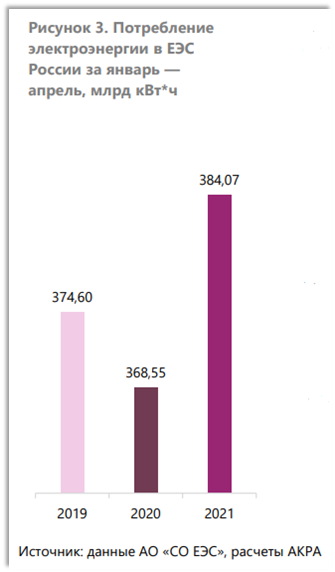
Electricity consumption on the wholesale/retail electricity and capacity markets, as well as within the Unified Energy System (UES) of Russia, increased in early 2021.
According to JSC System Operator of the Unified Energy System (SO UES, JSC), electricity consumption in Russia in the first four months of 2021 increased by 4.2% and 2.5% respectively compared to 2020 and 2019. The authors attribute this growth to the colder weather in 2021, as well as the Russian power sector recovery amid growing demand from the domestic economy and the recovery of regional business activity, while power consumption was lower in 2020 due to warmer weather and coronavirus restrictions.
Payment arrears have decreased in the wholesale electricity and capacity market.
The authors calculations confirm an increase in electricity consumption and prices in the wholesale electricity and capacity market for January-April 2021 compared to the same period in 2020. Also, the total debt on the wholesale electricity and capacity market in early 2021 is lower than at the end of April last year and the year before.
ACRA experts note that the improvement in 2021 is due to the debt restructuring agreement, such as PJSC Rossetis subsidiaries in the North Caucasus. Under it, the companies debts to electricity producers were restructured.
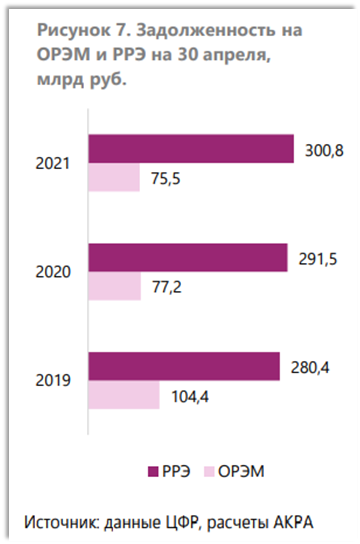
Despite a slight decrease in arrears, the amount of debt owed by end-users in the retail electricity market is much higher than in the wholesale electricity and capacity market.
The study points out that while the debt level in the wholesale electricity and capacity market (WECM) is declining, the situation in the retail electricity market (REM) is the opposite. Even though there is a small reduction in customer debt at the beginning of 2021, the amount owed is significantly higher than the level of debt in the WECM.
The authors specify that the slowdown in the growth rate of arrears in the REM can be explained by improved payment discipline across all consumer categories. At the same time, a significant decrease in debts in the WECM and a large gap between debts in the WECM and REM is due (according to ACRA) to the adjustment of obligations in the WECM in terms of writing off bad debts, as well as compensation by energy supply companies for debts of end consumers.
According to the authors, debts of end consumers in the retail market for electricity supplied primarily fall on power supply companies, which may lead to their bankruptcy and deprivation of the wholesale electricity market status, and on grid and generation companies, which may lead to insufficient funds to cover their operating and capital costs needed to maintain the reliability of UES of Russia.
For more information, see the special sections of the Roscongress Foundation Information and Analytical System: Energy, Standard and Quality of Life, Infrastructure Development, which focus on energy and infrastructure security as well as on improving the standard of living and quality of life of the countrys citizens.