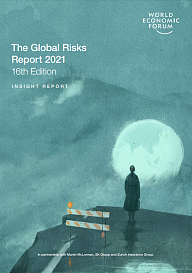
The World Economic Forum’s Global Risks Report 2021 analyses the risks arising from societal fractures which become apparent in various spheres of society. The report assesses the ability of the global community to tackle the world’s greatest challenges requiring societal cohesion and global cooperation. It also studies new risks that have emerged as a direct result of the COVID-19 pandemic. The foundation of the report is the annual Global Risks Perception Survey, completed by over 650 members of the World Economic Forum’s communities.
The Roscongress Foundation presents the salient points of the publication accompanied by fragments of broadcasts of relevant panel discussions from the business programme of international events held by the Roscongress Foundation.
Economic fragility and societal divisions are set to increase. One of the reasons is the COVID-19 pandemic.
Underlying disparities in healthcare, education, financial stability, and technology have led the crisis to disproportionately impact certain groups and countries. Not only has COVID-19 caused more than two million deaths, but the long-term economic impacts will continue to have devastating consequences. The pandemic’s economic shockwave—including massive job losses—will immediately increase inequality, but so can an uneven recovery. Nearly 60% of respondents to the survey conducted by World Economic Forum (Global Risks Perception Survey, GRPS) identified «infectious diseases» and «livelihood crises» as the top short-term threats to the world.
Existing business trends have been given fresh momentum by the crisis. The business risks emanating from existing trends have been amplified by the crisis and include stagnation in advanced economies and lost potential in emerging and developing markets, the collapse of small businesses, widening the gaps between major and minor companies and reducing market dynamism, and exacerbation of inequality; making it harder to achieve long-term sustainable development.
Video: https://roscongress.org/sessions/sleduyushchie-20-let/search/#02:21:46.170
Growing digital divides and technology adoption pose concerns.
COVID-19 has accelerated the Fourth Industrial Revolution, expanding the digitalization of human interaction, e-commerce, online education, and remote work. These shifts will transform society long after the pandemic and promise huge benefits—the ability to telework and rapid vaccine development are two examples. But they are also exacerbating risks and creating inequalities. Respondents to the GRPS rated «digital inequality» as a critical short-term threat.
A widening digital gap can worsen societal fractures and undermine prospects for an inclusive recovery. Progress towards digital inclusivity is threatened by growing digital dependency, rapidly accelerating automation, information suppression and manipulation, gaps in technology regulation and gaps in technology skills and capabilities.
Climate change continues to be a looming risk as global cooperation weakens.
Climate change continues to be a catastrophic risk. Although lockdowns worldwide caused global emissions to fall in the first half of 2020, evidence from the 2008–2009 Financial Crisis warns that emissions could bounce back. A shift towards greener economies cannot be delayed until the shocks of the pandemic subside. «Climate action failure» is the most impactful and second most likely long-term risk identified in the GRPS.
Responses to the pandemic have caused new domestic and geopolitical tensions that threaten stability. Middle powers—influential states that together represent a greater share of the global economy that the US and China combined—often champion multilateral cooperation in trade, diplomacy, climate, security and, most recently, global health. However, if geopolitical tensions persist, middle powers will struggle to facilitate a global recovery—at a time when international coordination is essential—and reinforce resilience against future crises. GRPS respondents signal a challenging geopolitical outlook marked by «interstate relations fracture», «interstate conflict» and "resource geopolitization"—all forecasted as critical threats to the world in three to five years.
For more information, see the special sections of the Roscongress Foundation Information and Analytical System: Sustainable Development and Digitalization about global challenges and technology issues; Economic Inequality, StayHomeEconomy and COVID-19 about possible ways to stabilize the economy during the pandemic; and Climate Change about environmental issues.