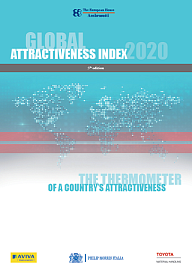
Experts from The European House Ambrosetti have compiled their 5th annual Global Attractiveness Index, highlighting the main attractiveness factors and the consequences of the COVID-19 pandemic on the countrys attractiveness level.
Analysts of the Roscongress Foundation have identified the main theses of this study, accompanying each of them with a relevant piece of video broadcasts of panel discussions held as part of the business programs of key events held by the Foundation.
The positions of countries in the rating of attractiveness do not tend to change dramatically. The correlation between the 2019 and 2020 results is 0.995. In 2020, only 15 countries out of 144 changed their place in the ranking by more than 10 points, and all these countries are not higher than 65th place.
The country attractiveness index correlates well with the indicators of foreign direct investment (0.69) and gross fixed investment (0.75) and determines the need to increase investment attractiveness, which is an extremely difficult task in the absence of long-term plans for the development of industries, regions and the national economy as a whole.
One of the most dangerous consequences of the current crisis is a sharp increase in government budget deficits. In such conditions, the ability to effectively allocate public (and private) spending on the implementation of long-term projects and strategies that can change the economic system becomes even more important. Thus, industrial policy should again enter the trend, viewed as cooperation between the public and private sectors to achieve strategic goals in the long term, pushed aside by the developed countries, which almost completely left the strategic choice to the market.
The authors of the study gave forecasts of the results of the Country Attractiveness Index for the future. According to them, most European countries, including Russia, carry serious risks of lowering their positions in the rating in the future, due to the COVID-19 pandemic. The least negative impact of the pandemic among the first 30 countries is predicted for Japan, Singapore, Switzerland, New Zealand and Iceland. As you can see, the results of future ratings will be geographically adjusted.
The country attractiveness index is calculated on the basis of 6 KPI blocks reflecting the dynamics and sustainability of development. From the point of view of the dynamics of development, Russia needs to improve its place in terms of efficiency. For 4 out of 5 indicators of this block, Russia is not included in the first 60 countries (in terms of the unemployment level- 63rd place, in terms of the logistics performance index 74, according to the rule of law index 78, in terms of the total tax rate 105).
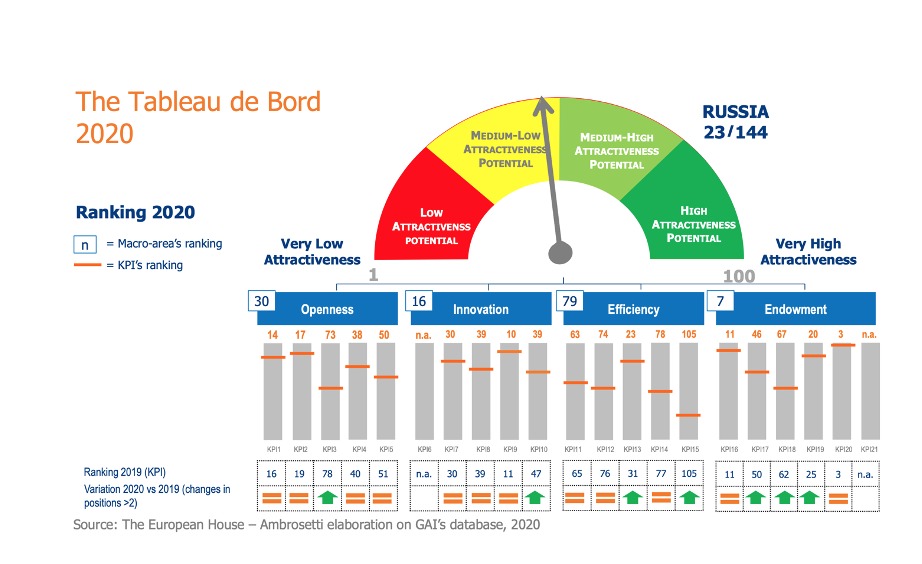
From the point of view of sustainability indicators, the results of Russia in this block of indicators, starting from 2016, were in the group of countries with a low level of attractiveness. These indicators include mortality associated with environmental pollution; the number of suicides; population exposed to risk of poverty; people affected by natural disasters, etc.
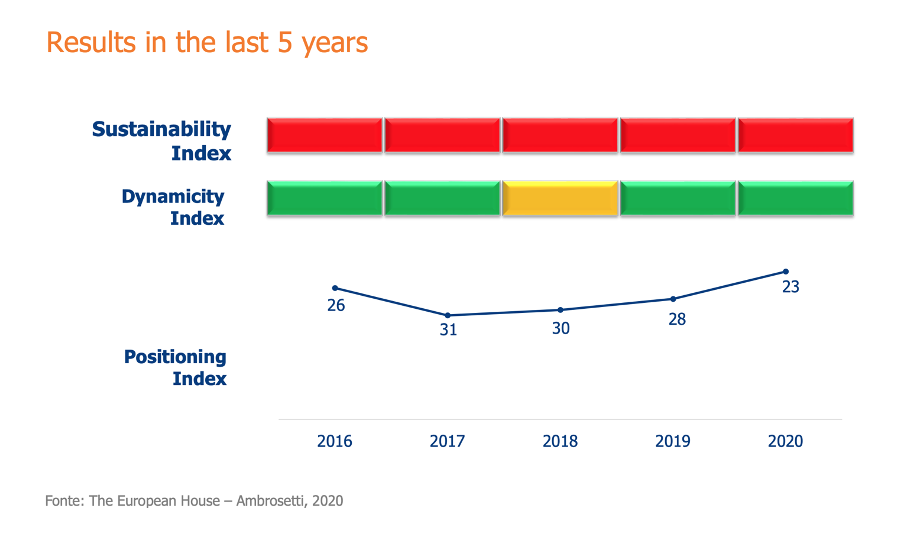
Brief summary of results for Russia.
We also invite you to familiarize yourself with other materials posted in special sections of the Roscongress Information and Analytical System StayHomeEconomy, State Strategic Planning and Investment climate, devoted to possible ways to stabilize the economy in a pandemic.