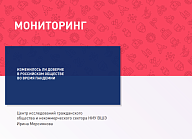
The article analyzes the phenomenon of trust in Russian society during the coronavirus pandemic. The research is based on 2012 telephone interviews conducted on a nationally representative sample from April 1 to May 3, 2020 as part of the civil society monitoring performed by the Center for Civil Society and Nonprofit Sector Research with support from the HSE Basic Research Program since 2006.
Roscongress Foundation analysts highlighted the main theses of this article, accompanying each of them with suitable fragments of video broadcasts of panel discussions held as part of business programs of the key events hosted by the Foundation.
Trust as a phenomenon of «social glue» in society is influenced not only by the positive or negative attitude of citizens, but also by a whole complex of factors, such as human resources, the set of social and cultural conditions, etc.
In 2020, in the midst of social restrictions in society, a quarter of respondents (26%), answering the question: «Do you think most people can be trusted, or should you be careful in dealing with people?», said that most people can be trusted. Those who chose the option «you should be careful while dealing with people» turned out to be much more — 67%.
A third of the Russians believe that over the past month the level of people’s trust in each other has decreased, and every fifth Russian has become more cautious towards strangers around them.
The authors of the study note that over the entire period of monitoring, the percentage of respondents who believe that most people can be trusted was in the range of 17-19% until 2014, after which a steady growth began to be observed along with the growth of patriotic feelings in Russian society. Over the past 5 years, this indicator has been in the range of 21-28%.
Experts of Center for Civil Society and Nonprofit Sector Research of HSE note that to date, the indicators of generalized trust in our country have not changed in the difficult conditions of self-isolation.
Video: https://roscongress.org/sessions/-post-truth-/search/#00:27:44.512
One in four Russians has experience of helping those in need in connection with the spread of coronavirus — this also shows that the presence of assistance experience has no strict correlation with the level of generalized trust.
In the conditions of self-isolation, a number of Russians had to resort to help in solving everyday issues. Among the «trusting» Russians, there is a much larger proportion of those who are ready to help strangers in need who find themselves in self-isolation. In addition, among Russians who believe that people should be treated with caution, there is a higher proportion of those who are not ready to help strangers who find themselves in self-isolation (36% vs. 25%).
However, every fourth Russian (26%) has experience in helping those in need in connection with the coronavirus spread. The authors of the study suggest that such a volume of informal support indirectly indicates the availability of assistance from official state institutions, and the presence of assistance experience does not have a strong correlation with the level of generalized trust.
Since 2006, there has been a high level of trust in the inner circle of people in Russia, and in 2020 the level of trust in the close social distance has even increased.
In 2020, 75% of respondents believe that it is possible to trust the majority of people around, and only 21% of respondents believe that one should be careful in dealing with people close to them. The picture of a high level of trust in the inner circle persisted all the years of monitoring, and in 2020 the level of trust in the close social distance increased. The authors of the study note that today it is impossible to make an accurate conclusion about the reason for such growth, perhaps the answer to this question will give an analysis of future changes in the dynamics of events when the survey returns to the usual face-to-face format of personal interviews.
The data from the current survey suggest that people who have more trust in others in their immediate environment are more likely to buy food and take out garbage for their neighbors who find themselves in self-isolation. The connection between trust in a close social distance and helping neighbors in solving everyday issues is traced more clearly than in the case of generalized trust.
Generally speaking, based on the research data, the authors conclude that with a relatively low (compared to many other countries) level of generalized trust, Russians’ willingness to help is relatively high.
This article is part of the HSE Analytical Bulletin on the Economic and Social Consequences of Coronavirus in Russia and globally. You can find the full version of the publication here.
We also invite you to get acquainted with other materials posted in StayHomeEconomy, Level and quality of life and Volunteering, special sections of the Roscongress Information and Analytical System, dedicated to the possible ways to stabilize the economy in a pandemic, as well as the promotion of initiatives related to socio-economic development of the state.