Main features of the World Energy Issues Monitor 2020 report
Established in 1923, the World Energy Council (WEC) today is the principal impartial network of energy leaders and practitioners promoting an affordable, stable and environmentally sensitive energy system globally. This eleventh iteration of the Issues Monitor, a series of reports published annually by the World Energy Council, is based on a survey of more than 3,000 energy leaders (CEOs, Ministers and experts) in 104 countries. New this year, the Issues Monitor also provides readers with the views of the individual customer, detailing their perceptions of their role in the overall energy system.
Global Perspectives
Based on individual country analyses and commentaries, the WEC experts formed a picture of five categories of challenges at national, regional, and global levels: macroeconomic risks, business environment, geopolitics, energy vision, technology.
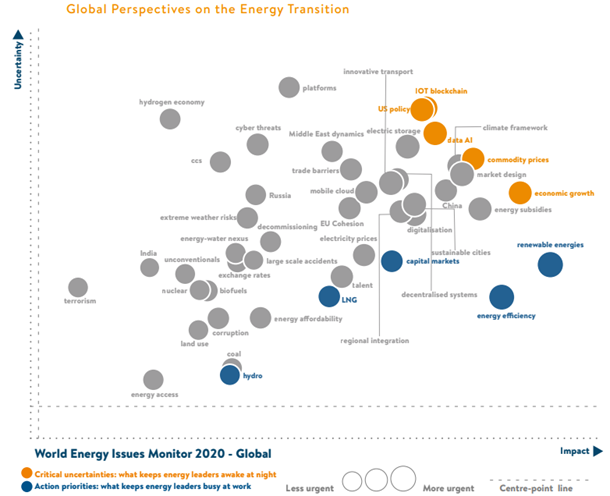
Based on the results obtained from the national and regional analyses, three main insights have emerged:
- Macroeconomic and geopolitical issues define Critical Uncertainties
The strained trade relations between the United States and China have led to higher uncertainty across all regions. Volatile commodity prices is another source of instability for both energy consumers and producers. Also, uncertainty remains around the impact of intensifying extreme weather events and the need to adopt climate adaptation and mitigation measures.
- Technology issues define Action Priorities
Governments are beginning to design pathways for the wider adoption of renewables, digitalisation, energy efficiency, energy storage, and other innovative technologies as part of national energy transitions. Energy Efficiency appears as a key theme, with numerous countries adopting plans to improve the performance of appliances, buildings, the electricity and gas distribution grids. Distributed systems are being promoted to achieve accessibility and decarbonisation goals, but project financing in emerging markets remains a challenge.
- Regional integration is a «desired» means of improving energy security
Energy integration can increase regional cooperation and diversify countries sources of energy supply to enhance energy supply security. Still, although regional integration is seen as important for all countries surveyed, there remains a strong focus on self-reliance. Countries reliant upon oil and gas imports recognise that this dependency renders their economies vulnerable to supply disruptions. Use of renewables can help countries diversify the energy mix.
Key Trends in Energy
The report highlights the following key trends in the energy industry which is currently in the process of transition.
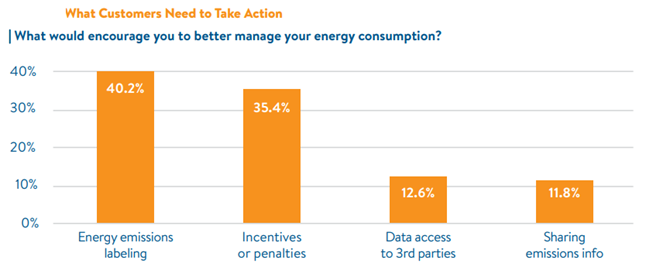
- The role of the customer is likely to continue growing in the next decade
The focus for the 2010s was about trying to automate and upgrade the energy system and set targets to move the energy transition forward. Digitalisation accelerated the transition of all sectors towards a more customer-centric environment. As a result, the 2020s may very well be about realising those targets through a transition from activism to action.
- Carbon Capture & Storage (CCS) is gaining in importance within the Oil & Gas sector
In comparing response from the Oil & Gas sector in 2015 with 2019, the WEC experts found that almost half of respondents identified Carbon Capture & Storage (CCS) as a high impact issue in 2019, up from about a third in 2015. According to the latest report from the Global CCS Institute, there are now 19 large-scale CCS projects in operation globally with four projects under construction, and a further 28 in various stages of development.
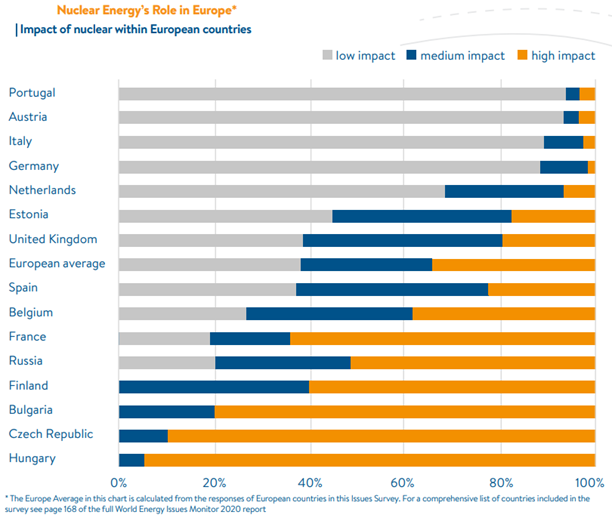
- Nuclear power remains important in Europe
The Council investigated how European energy leaders perceive nuclear energy. Opinions remain polarised but in many European countries, nuclear power is increasingly recognised as a carbon-free energy source and potentially an integral part of the future energy mix.