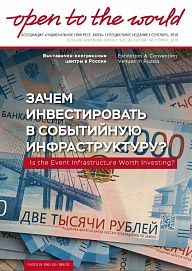
Construction of new modern congress and hotel infrastructure will not only attract large volumes of investments to the region, but also stimulate the development of the event industry. This in return will help strengthen the local and national economy. Since recently, Russia has hosted multiple international events: the Olympic Games, the FIFA World Cup, international summits. Residents and guests of Russian cities witnessed much transformation and changes in infrastructure. Airports, railway stations, highways and junctions, stadiums, hotels, and convention centers were built in major Russian cities. Notably, considerable changes have come not only to Moscow or St. Petersburg but to far regions of the country as well. The publication cites examples of such transformations in Ufa, Yaroslavl, Chelyabinsk, and other cities to demonstrate how infrastructure changes can act as a driver for increasing productivity and investment appeal.
Its hard to overestimate the impact of the event infrastructure on the regions economic and social parameters (attraction of investments into the region, increased revenue of market players, multiplicative economic effect in related sectors, etc.), on its image and promotion (better regions brand recognition worldwide, improved status of the region as a cultural, business, and innovation center, etc.), and on contacts and business (increased number of contracts and the total sum of contracts signed during and after the event, new participants on the industry market, export of products and services, etc.).
The best venues are developing as rapidly as the event industry itself. Today, the demand is the highest for unusual places to host an event and for all kinds of technological innovations. The main trends here are: using unconventional venues, promoting brand recognition at venues, employing cutting-edge technologies in event formats and in interpreting, etc.
The publication cites opinions of industry professionals about the relevance of event infrastructure and about its specific features in Russia and in other countries, such as Germany, China, and Japan. Specially for the opening of the Eastern Economic Forum the authors prepared materials on the event infrastructure in Primorsky Krai and Kamchatka. Besides, the publication provides rankings of the largest exhibition and convention complexes in Russia and globally, and gives opinions of industry professionals on some specific burning issues such as criteria for selecting a venue, methods of assessing the effectiveness of a venue, developing venues, their pricing and product strategy, etc.
.png)