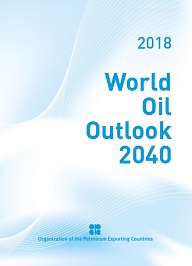
In their report the experts from the Organization of the Petroleum Exporting Countries analyze macroeconomic indicators that are expected to have a direct effect on market environment in the global market for oil and other fossil fuels. Population growth, the size of the working-age population, urbanization levels, and immigration play an important role in shaping the future energy and oil market. Global GDP growth rates are forecast to decrease. This will be accompanied by major regional shifts in energy consumption towards the developing countries. For example, the share of China and India is expected to grow, while the shares of Europe and Northern America will decrease.
In the baseline scenario, total primary energy demand is expected to increase by 91 mboe/d (by 33%) between 2015 and 2040 to reach 365 mboe/d in 2040. Oil demand, in its turn, is expected to increase by 14.5 mb/d, reaching 111.7 mb/d in 2040. Fossil fuels (oil, gas, and coal) are projected to remain the dominant component in the global energy mix, with a share of 75% in 2040. Oil is forecast to remain the largest contributor to the energy mix, with a share of nearly 28% in 2040, although growth rates for natural gas and renewable energy sources will be higher.
.png)
From the sectoral point of view, road transportation continues to lead demand, but petrochemicals see the largest increase and aviation is the fastest growing sector.
.png)
At the same time, the authors mention a potential supply shortage on the oil market. Non-OPEC liquids supply is projected to peak at just below 67 mb/d in the late 2020s. Thereafter, it declines slowly to average 62.6 mb/d by 2040. As for investments in the oil sector, during the period until 2040, the oil industrys demand for investments will amount to roughly USD 11 trillion, with upstream accounting for USD 8.3 trillion, downstream for USD 1.5 trillion, and midstream (extraction, refining, and transportation) for USD 1 trillion.
A separate chapter of the report underlines the necessity for an integrated and coherent strategy in order to achieve the Sustainable Development Goal (SDG 7) targets. Another chapter studies how fossil fuels extraction and processing interrelates with the global challenge of climate change. The authors state that policymakers in energy consuming and producing countries must continue to promote cutting-edge technologies in the power generating industry in order to enhance energy security and energy efficiency, alleviate energy poverty, and facilitate global economic development.