Invest in Russia — invest in Russian regions!
All analytics

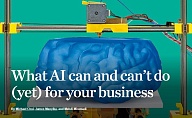
What artificial intelligence can and cannot do (yet) for your business?

Research
26 March 2018

Today artificial intelligence seems to be everywhere. Moreover, AI will be in just about every product and service we buy and use. And at the same time, concerns about AI’s implications are rising: we worry about the impact of AI-enabled automation on the workplace, employment, and society.

AI’s challenges and limitations are creating a «moving target»: it is hard to reach a leading edge that is always advancing. In addition, when businesses discontinue to race, there is a yawning divide between leaders and laggards which can readily be seen, for example, across and within some sectors.


Main limitations associated with the AI application include data labelling (tagging) needed to train the system in creating respective commands and handle massive data sets amounting to thousands of data records to become relatively good at classification tasks and, in some cases, millions of them to perform at the level of humans. AI processes and techniques are quite difficult to explain and understand. They summarize all accumulated data which creates a barrier to the adaptation to certain situations.

Finally, one more problem is a focus on algorithms and built data chains rather than deviation from them. Nevertheless, methods for using complicated data sets, fresh thinking, adaptation and constant update of AI knowledge and skills can be seen as a solution to the above problems. You should use and try to use the most innovative ideas and trends to remain competitive and always stay ahead of your opponents on the way to the «moving target». If you wish to become a leader in this field, understand key important issues thwarting AI development progress and are able to utilise available leverages and tools to overcome these limitations, then this article is what you need.

Anlytics on the topic

All analytics
Expert opinion
24 May 2018
“Business is a competition of management systems”

Peter Strom, Vice President of Operations at the Adizes Institute, speaks on how Russian management is changing, what motivates employees and what the development of technology will lead to, in an interview with the Roscongress Foundation news service.

Articles
20 October 2020
Digital Ruble: Opportunities and Options

Alexey Zabotkin, Deputy Chairman of the Bank of Russia, describes the changes in the digital payment market and consumer behavior, as well as tells about the advisability of creating an additional form of money that meets the requirements of the digital era: the digital currency of the Central Bank.

Expert opinion
3 June 2020
The broad penetration of the Internet is ultimately better for the safety of a country

In 2011 Eric Schmidt — one of the most renowned figures in the IT industry and at the time Executive Chairman of Google — spoke at the session «The World According to Google» at the St. Petersburg International Economic Forum. What he said turned out to be remarkably prophetic, particularly when viewed from the context of the current COVID-19 pandemic and our experience of self-isolation.

Research
26 November 2019
Connectivity in the Digital Age. Digital Futures of Trade and Economic Cooperation in Eurasia

This background paper of the International Institute for Applied Systems Analysis aims to review the current level of digitalization and technological development of China, the EU, and the EAEU, analyze their digitalization strategies, and give preliminary recommendations on prospects of cooperation in the field of digitalization in Greater Eurasia.