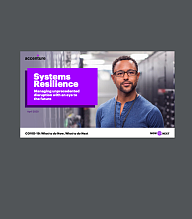
In this publication, Accenture discusses systems resilience, i.e. a systems ability to operate with minimal impact on critical business and operational processes during a major disruptionsuch as the unfolding COVID-19 crisis. Accenture has identified six resilience building blocks that will enable a quick response to critical systems vulnerabilities.
The Roscongress Foundation presents the salient points of the publication accompanied by fragments of broadcasts of relevant panel discussions from the business programme of international events held by the Roscongress Foundation.
Systems resilience is a systems ability to operate during a major disruption or crisis, with minimal impact on critical business and operational processes. In the unfolding COVID-19 crisis, systems resilience is being tested like never before.
The COVID-19 crisis necessitates a rapid change in organizations approach to work and puts systems resilience to the test. Accentures definition of systems includes applications, architecture, data, cloud, infrastructure and network. In the unfolding COVID-19 crisis, systems resilience is being tested like never before. IT and business leaders must ensure that their organizations can continue to operate through this unprecedented disruption by quickly addressing the stability of critical business processes and underlying systems.
As businesses juggle a range of new systems priorities and challenges―business continuity risks, sudden changes in volume, real-time decision-making, workforce productivity, security risks―leaders must act quickly to address immediate systems resilience issues and lay a foundation for the future.
Accentures research shows significant variation in systems resilience across industries. Resilience was scored based on two categories: technology adoption and organizational flexibility. Adoption of technologies such as cloud, DevSecOps, microservices, and containers, makes enterprise systems fast and flexible, while organizational flexibility captures actions that companies take to establish the right culture and governance.
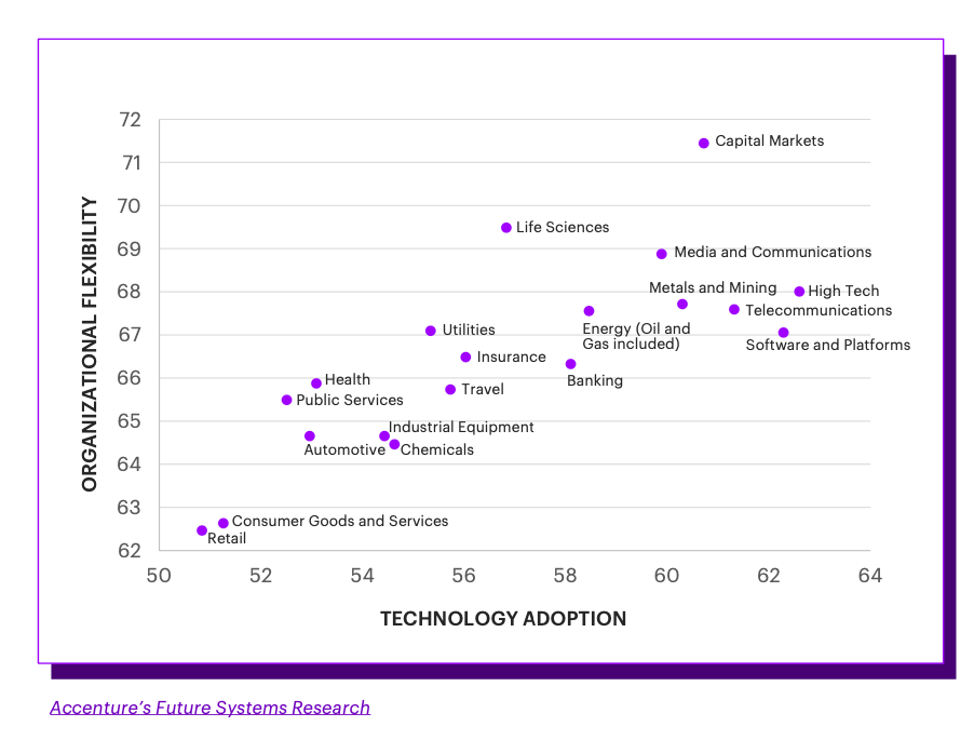
Accentures survey conducted in 2019 revealed that only 10% of 8,300 companies surveyed had managed to attain a satisfactory level of systems resilience.
Systems resilience describes a systems ability to operate during a major disruption or crisis, with minimal impact on critical business and operational processes. This means preventing outages, mitigating their impact, or recovering from them.
To help organizations quickly address systems resilience issues, Accenture has defined the following six resilience building blocks that will enable a quick response to critical systems vulnerabilities:
1. Elastic digital workplace: Protect people and productivity, when its necessary to become fully remote overnight.
2. Hyper automation: Mitigate the impact of systems disruption, free up human resource capacity and streamline IT workforce management.
3. Architecture & performance engineering: Quickly resolve critical systems availability and performance issues.
4. Cloud acceleration & optimization: Manage risk, deploy instant innovation and optimize cloud performance and cost.
5. Service continuity: Flex to support critical in-flight services or deliver new IT projects.
6. Cybersecurity: Secure customers, people and systems wherever they are.
Video: https://roscongress.org/sessions/analiziruy-vse-revolyutsiya-bolshikh-dannykh/search/#00:44:25.471
Companies are operating under a new reality that puts great strain on their systems. Once we reach the other side of this pandemic, it will be important to establish long-term strategies for greater resilience.
Accenture recommends that business leaders define long-term transformation strategies that prioritize and address antiquated applications, architectures and infrastructure, highly manual processes, and underfunded cyber resilience.
Companies are advised to self-fund their transformation through small incremental programs that drive efficiency and free up capital. Also, Accenture urges companies to leverage ecosystem partners to shift to an asset-light model and mitigate vulnerable dependencies, choosing partners resilient to global risks.
Then lessons learned from the experience should be applied to create a systems and talent roadmap that better prepares the company for future disruptions.
For more information about possible ways to stabilize the economy during the pandemic, please see the StayHomeEconomy and COVID-19 special sections of the Roscongress information and analytical system, and the Labour productivity gains and Entrepreneurship sections about measures aimed at stimulating economic progress.