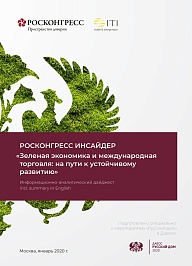
The authors of the report assert that the basis for the transition to sustainable development is the formation of a green economy. Reducing environmental risks and repairing ecological scarcities are aimed at improving welfare and social equity. Scientific research demonstrates that the current global efforts are insufficient to mitigate harmful environmental effects. One possible reason why the guiding principles and directives set down in international agreements turn out to be hard to implement is a lack of common understanding between countries about the contribution they need to make towards this task. Also, to assess the progress in the transition to a green economy, it’s necessary to make a more extensive use of instruments for quantitative valuation of environmental changes.
The transition to an inclusive green economy is facilitated by the activities of dedicated international initiatives and platforms within the UN, OECD, the World Bank, etc. Russia, in its turn, is actively creating the conditions for a green economy by implementing targeted programs, informing interested parties, and providing platforms for debate.
To attain their objectives, countries must transform their industrial systems to align them with ecological requirements and ensure adequate financing and investment in natural capital. Meanwhile, it becomes evident that such a transformation is impossible without cooperation at the international level. Each country must choose its own green transformation path, starting with measures that bring the greatest short-term benefits — for example, improving energy efficiency or natural resources management.
Investment in natural capital is viewed as one of the pillars of green economy. According to the data by Climate Bonds Initiative, over the first 9 months of 2019 green bond issuance globally increased by 73.2% compared to the same period of 2018, reaching USD 180.6 bn.
International trade is an important component of global and regional GDP. The share of global export in global GDP in 2014-18 averaged 22.2%. Also, responsible use of international trade mechanisms helps solve the problem of the depletion of exhaustible natural resources, as well as the problem of excessive use of environmentally harmful practices and technologies. Sustainable development can be supported by first, restricting trade in products that are hazardous to health or the environment, and second, liberalizing trade in green products and creating favorable conditions for using them.
Calculations done by the authors of the report demonstrate that the dynamics of global export of hazardous products are in line with the trends found in total global export over the period of 2014-18, i.e. a decline in 2014-16 with a subsequent rise in 2017-18. At the same time, global export of some products that are detrimental to human health and the environment, such as plastic waste, demonstrates a continuing trend to decline.
As for trends in international trade in green products, one illustrative example here is the segment of motor vehicles with electric engines where global export shows positive dynamics in 2017-18. Experts believe that besides developing trade, it’s also necessary to develop infrastructure and create favorable conditions for alternative modes of mobility.
Overall, based on an analysis of major global sources, the authors or the report have concluded that green economy and international trade in green products are definitely stimulating sustainable development and are the key to attaining the Sustainable Development Goals.
Close