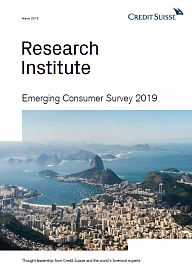
The Credit Suisse Emerging Consumer Survey is a study that draws on the findings of 13,285 detailed face-to-face interviews with consumers across eight emerging economies which reflect USD 10.7 trillion of consumption. These consumers continue to redraw the global consumption map as their incomes rise. The study covers Brazil, China, India, Indonesia, Mexico, Russia, Turkey, and Thailand.
In recent surveys carried out by Credit Suisse, the prospects for the Asian consumer have stood out as the brightest. India is again topping the sentiment scorecard supported by positive income characteristics. China ranks third, displaying an all-time low level of income expectations. The authors note that real wages in China are currently increasing at their slowest pace for seven years. The most notable and positive regional development in 2018 has been a rapid improvement in consumer sentiment in Latin America. Brazil ranks second in the consumer sentiment scorecard and, compared to Mexico, has a more secure medium-term outlook in macroeconomic terms.
Alongside the country contrasts, the study delves into structural and behavioral themes. The authors identify general drivers of change shaping consumer behavior, such as a surge in internet access and increased penetration of smartphones. The demographic dynamics are crucial of course, and, as the authors compare and contrast India and China in this regard and the 2.7 billion consumers they represent, they observe that both markets have benefited from a demographic dividend, but each country is at a different stage. China is now already at a demographically higher stage of development than India. Yet, with its working-age population soon to surpass that of China, India has better long-term demographics for growth.
When assessing the growth prospects of consumer end-markets, the role played by the «millennial» (Generation Y) consumer is key. The study provides a unique picture of the current priorities and preferences of this important segment across these markets and exposes some myths along the way. Overall, the picture that emerges indicates a greater appetite of millennials for spending on health and convenience-related lifestyle products (which aren’t necessarily luxury items), video games and e-sports. The authors note a shift to renting a more convenient lifestyle, evidenced by the fact that food delivery services are gaining in popularity. By contrast, spending on cars and holidays has weakened in this group of consumers.