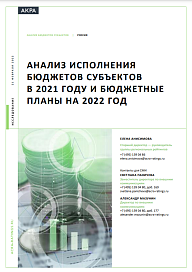
In this report, ACRA analyses budget execution in Russias federal subjects in 2021 and their budget plans for 2022.
The Roscongress Foundation presents the salient points of the publication accompanied by fragments of broadcasts of relevant panel discussions from the business programme of international events held by the Roscongress Foundation.
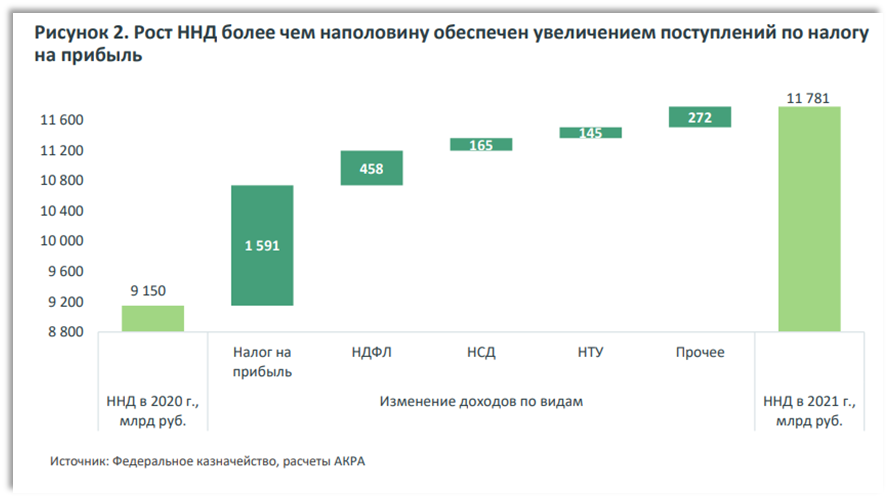
More than half of the growth of federal subjects revenues came from corporate income tax.
The total revenues of regional non-consolidated budgets grew by 18% year-on-year in 2021. Tax and non-tax revenues (TNTR), which increased by 29% compared to 2020, accounted for all of this growth. ACRA analysts observe that total revenues only fell in three Russian regions. The Republic of Crimea recorded a 6% fall in revenues, while in the Kaliningrad Oblast and the Chukotka Autonomous Okrug revenues only fell by 2% and 1%, respectively. The latter region was the only region to experience a decline of TNTR, which amounted to 10%. The authors of the report specify that more than half of TNTR growth came from corporate income tax, which grew by 55% year-on-year, or by RUB 1.6 tln. This growth contributed 60% of the growth of TNTR in 2021.
At the same time, ACRA experts point out that it is important to take account of conservative budget planning. It is standard practice, and there was little cause for optimism in late 2020, when plans for 2021 were made. As a result, initially planned total budget revenues turned out to be 28% lower than the final figures. Some regions significantly exceeded their revenue plans by 40% or more. ACRA asserts that although the market situation made the main contribution to the aggregate budget surplus in 2021, the impact of last years partial economic recovery and the low base effect of 2020 cannot be ignored.
In 2022, deficits will mostly be covered by the sources that do not increase debt.
This year, regions expect their total revenues to decline by 7% against 2021 (or by 8% excluding Moscow). Both TNTR and transfers will decrease. Most of the regions whose TNTR grew atypically in 2021 project that TNTR will decline in 2022. Some of these regions are the Lipetsk Region (a 37% decline), the Tyumen, Kursk and Vologda Regions (32%, 29% and 25% respectively).
Regions project that at the end of the current year, the total budget deficit will amount to RUB 715 bln. Оnly six regions expect an aggregate budget surplus. Four more regions rely upon a deficit-free budget. The remaining 75 regions (including Moscow) will end 2022 with a total deficit of RUB 1.1 tln. Of 66 regions that ended last year with a surplus, 36 regions have planned a deficit for 2022 that could potentially be financed not by borrowings but at the expense of their own liquidity (provided that the entire surplus could remain in the accounts of a region). Analysts note that more than a third of the regions accumulated a significant cushion of liquidity last year to ensure their financial sustainability. This is why, when financing their budget deficits, all regions in total (except Moscow) put a 44% reliance on sources that do not impact the amount of debt. Among these sources, account balances play the main role. Net bank loans will provide regions with a 33% coverage of planned deficits, and net proceeds from bond issuances 18%.
Video: https://roscongress.org/sessions/regionalnyy-byudzhet-potratit-nelzya-sekonomit/search/#00:34:42.560
Gain more insights about public administration and regional development in the State Budgets, Development Institutions and Support Mechanisms, and Regional Policies sections of the Roscongress Information and Analytical System.